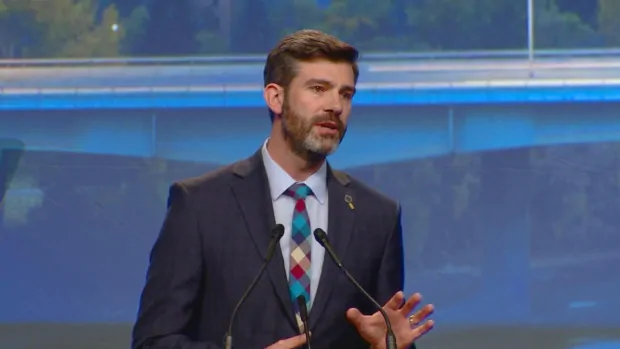
With Edmonton a political “island” once more, Mayor Don Iveson used his annual State of the City speech to send a message to Alberta Premier Jason Kenney: Don’t forget about us.
Of its 20 MLAs, Edmonton elected only one belonging to the governing United Conservative Party on April 16, which won 63 of the province’s 87 ridings.
Understandably, Iveson said Wednesday, this has led to anxiety and flashbacks to the 1990s, when the city was almost entirely represented by Liberal MLAs in the face of majority Progressive Conservative governments.
“Because, let’s face it: the last time this happened, Edmonton was gutted,” Iveson told members of the Edmonton Chamber of Commerce at the convention centre.
“While other parts of the province got attention, Edmonton bore the brunt of public service cuts.
“Our local economy suffered because a lot of purchasing power got yanked out due to layoffs. We had lots of skilled people — nurses, educators, even trades people — leave the city and the province as a result. We stagnated for a long time, and then we spent even longer catching up.”
But Iveson reminded the audience of Kenney’s election night comment that “Edmonton will continue to be deeply important” to the new government.
“I think I speak for all Edmontonians when I say, we’re going to hold him to that,” he said.
The Kenney government has identified oil and gas as one of its key priority areas, and Iveson acknowledged the vital role played by the energy sector in Edmonton. But, he added, “it’s not an either-or choice.
“We want our energy sector to succeed and we want all of our other industries to be able to thrive, no matter the price of oil,” he said.
To that end, Iveson listed three key areas that he urges the provincial government to continue to support:
- Infrastructure and transit, including money for LRT expansion, road upgrades and even the long-promised Lewis Farms Rec Centre and Library;
- Support for post-secondary institutions to ensure that the University of Alberta and NAIT remain “strong and stable”;
- And Edmonton’s “health assets,” specifically Alberta Health Services, which Iveson said offers researchers and innovators the ability to explore new protocols and procedures as well as housing one of the best health data sets in North America.
“They’re part of our unique horsepower,” Iveson said. “Undermine those advantages and you hobble your horsepower. And this could hamper not only Edmonton’s trajectory, but the economic recovery of Alberta as a whole.”
Iveson raised a February report, done by RBC and a not-for-profit called YouthfulCities, that ranked Edmonton as a top Canadian city for youth to live and to work, based on factors such as affordability, transportation, education and its strong support of entrepreneurs.
“Our city is emerging as a preferred destination for that next generation of innovators and thinkers and job-creators,” he said.
But, he said, Edmonton hasn’t reached this point on its own and it will continue to require government assistance.
“We are absolutely integral to the province’s future,” he said. “That’s the major message I am carrying to this new provincial government.”