Canada’s agriculture minister has made a formal request for Chinese authorities to allow Canadian canola experts to go to the country to help resolve an escalating trade dispute between the two countries.
Marie-Claude Bibeau says she sent a letter to her Chinese equivalent to receive a Canadian canola delegation that would be led by the President of the Canadian Food Inspection Agency, along with her team of plant health experts, and the support of technical experts from the Prairie provinces.
Parliamentarians including Bibeau and International Trade Minister Jim Carr said at a press conference on Monday that the federal government has formed a working group with many canola-producing provinces to try to resolve a situation that has seen Canadian canola sales to China dry up.
China alleges it has found pests in Canadian canola, and has revoked the licenses of two Canadian canola shippers, Richardson International, and Viterra.
But, there has been speculation that the allegations of dirty canola are just a red herring, and the clash is really about worsening geopolitical relations between the two countries as a result of the detenion of Meng Wanzhou in Vancouver late last year.
Carr disputed the notion that there are any problems with Canadian canola, and says it’s time for China to prove those unfair accusations if they can. “If there is a problem with our shipments, show us the science so our skilled and dedicated industry leaders may rectify it,” Carr said.
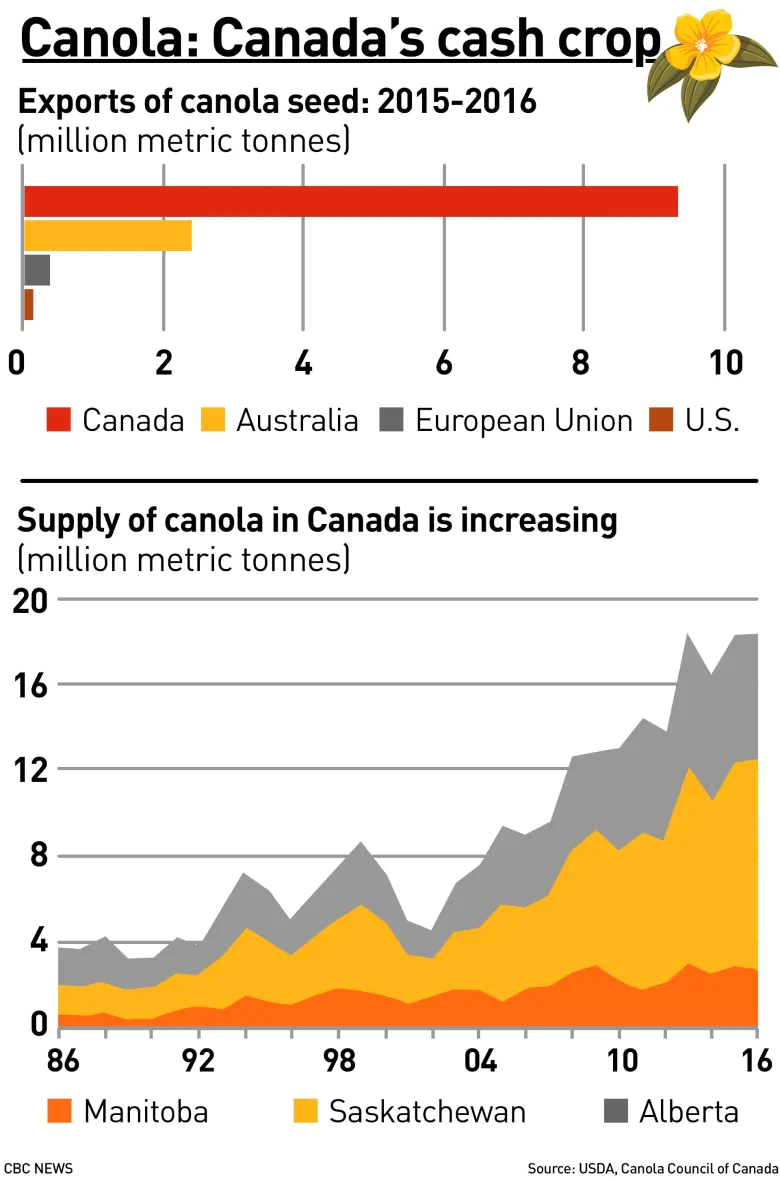
Canada exports more canola than anyone else, and China is a major customer. (Scott Galley/CBC)
“We think the next step is to … not only have a video conference but face to face conversation with experts from Canada and from China,” he told reporters.
The federal government says its working group will include the two companies hit by export bans, but also the group that represents the industry in Canada, and people from the governments of Manitoba, Saskatchewan and Alberta.
“We’re pleased that the government has recognized the seriousness of the issue and taken action,” said Jim Everson, president of the Canola Council of Canada. “As a group, we’ll be meeting right away to continue resolving the issue and to help the sector navigate the uncertainty it is causing.”
While so far only two Canadian canola companies have been hit by a ban, the Canola Council says all of its members have been reporting that orders for canola seed to China have been drying up, without explanation, for weeks.
Under normal circumstances, China is a major buyer of Canadian canola, accounting for approximately 40 per cent of all canola seed, oil and meal exports. Canola seed exports to China were worth $2.7 billion in 2018. Demand has been very strong until recent disruptions.
Ottawa has a number of programs designed to give financial assistance for farmers impacted by the sudden canola problem, and Bibeau says it’s possible that Ottawa will increase cash advances to them as situations warrant.