The crew of the Ethiopian Airlines jet that crashed shortly after takeoff last month performed all of the procedures recommended by Boeing when the plane started to nose dive but could not control it, according to a preliminary report released Thursday by Ethiopia’s government.
The report was based on data from the recorders of the Boeing 737 Max 8. Boeing declined to comment pending its review of the report.
The Max 8 has been under scrutiny since a Lion Air flight crashed off the coast of Indonesia under similar circumstances in October.
Investigators are looking into the role of a flight-control system known by its acronym, MCAS, which under some circumstances can automatically lower the plane’s nose to prevent an aerodynamic stall. The plane has been grounded worldwide pending a software fix that Boeing is rolling out, which still needs approval from the Federal Aviation Administration and other regulators.
The Ethiopian Airlines jet crashed shortly after takeoff from Addis Ababa on March 10 killing all 157 on board, including 18 Canadians.
Ethiopian investigators did not specifically mention the MCAS, but recommended that Boeing review “the aircraft flight control system related to the flight controllability.” They also recommended that aviation officials verify issues have been adequately addressed before allowing the planes to fly again.
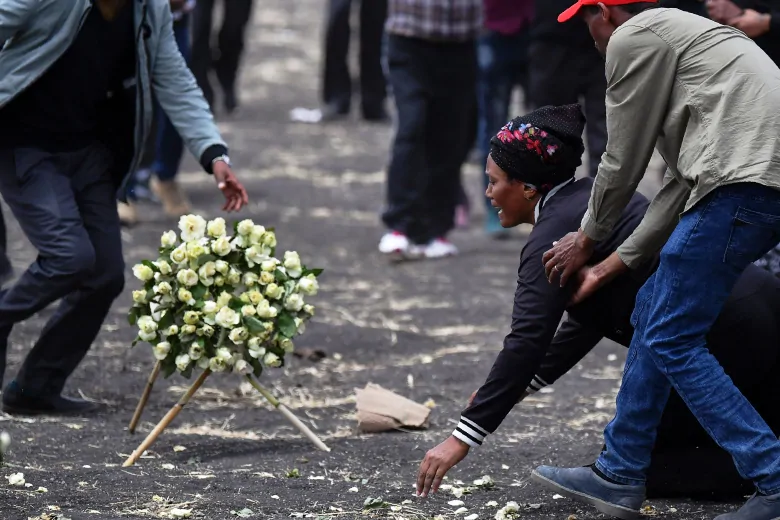
A distraught relative is assisted after she is overcome at the site where the Boeing 737 Max 8 went down. (Tony Karumba/AFP/Getty Images)
Investigators could not yet say whether there is a structural problem with the plane, Reuters reported. “We will analyze whether other problems were existing on this aircraft,” Amdye Ayalew Fanta, the head of the investigation, told the news conference, adding this would take between six months and a year.
Report links two 737 Max crashes, analyst says
Boeing is the focus of investigations by the U.S. Justice Department, the U.S. Transportation Department’s inspector general and congressional committees. Investigations are also looking at the role of the Federal Aviation Administration in the U.S., which certified the Max in 2017 and declined to ground it after the first deadly crash in October.
The FAA said in a statement that it is continuing to work toward a full understanding of what happened and will take appropriate action as findings become available.
David Hasse, an aviation analyst and editor of industry publication airliners.de in Berlin, says it is significant that the report found that the pilots followed the proper procedures, because that links the case more closely to the Lion Air crash.
“What is special about this case is that two crashes seem to have a very, very similar reason. This is something that is very rare in aviation. The question is whether the Boeing 737 Max should have been grounded after the Lion Air crash and before the Ethiopian Airlines crash,” said Hasse.
He noted that crash reports are not meant to assign legal blame and that it is too soon to know what the legal implications might be for Boeing, but it clearly raises the pressure on the company.
“If pilots sit there and follow the rules that have been given to them by the manufacturer, then they should be able to rely on the fact that they are correct,” Hasse said.