Eastern Libyan forces on Friday seized the former Tripoli International Airport on the southern outskirts of the capital, a spokesman for the forces said.
Ahmed Mismari also told reporters his troops were in control of Tarhouna and Aziziya, two towns near Tripoli. He said five of his fighters had been killed. Tripoli is home to Libya’s internationally recognized government.
The development comes as UN Secretary-General António Guterres said Friday he was “deeply concerned” after meeting eastern commander Khalifa Haftar in Libya to try to avert a renewed civil war as forces advanced on Tripoli.
Haftar’s Libyan National Army (LNA) said in the evening it had taken control of Tripoli’s airport.
The thrust by the LNA, allied to a parallel administration based in the east, is a dangerous escalation of a power struggle that has dragged on since the overthrow of Moammar Gadhafi in 2011.
Hopes to avoid ‘bloody confrontation’
“I leave Libya with a heavy heart and deeply concerned,” Guterres said on Twitter.
“I still hope it is possible to avoid a bloody confrontation in and around Tripoli. The UN is committed to facilitating a political solution and, whatever happens, the UN is committed to supporting the Libyan people.”
Al Arabiya TV said Haftar told Guterres that the operation would continue until terrorism is defeated.
Tripoli is the ultimate prize for Haftar’s eastern parallel government. In 2014, he assembled former Gadhafi soldiers and, in a three-year battle, seized the main eastern city of Benghazi, then this year took the south with its oilfields.
The escalation surprised the UN. Guterres had been in the capital this week to help organize a national reconciliation conference planned for later this month.
But on Thursday, LNA forces took Gharyan, about 80 kilometres south of Tripoli, after skirmishes with forces allied to Tripoli-based, UN-backed Prime Minister Fayez al-Sarraj.
They moved further north, coming as close as 40 kilometres to Tripoli by taking the village of Suq al Khamis after some fighting, a resident and an eastern military source said.
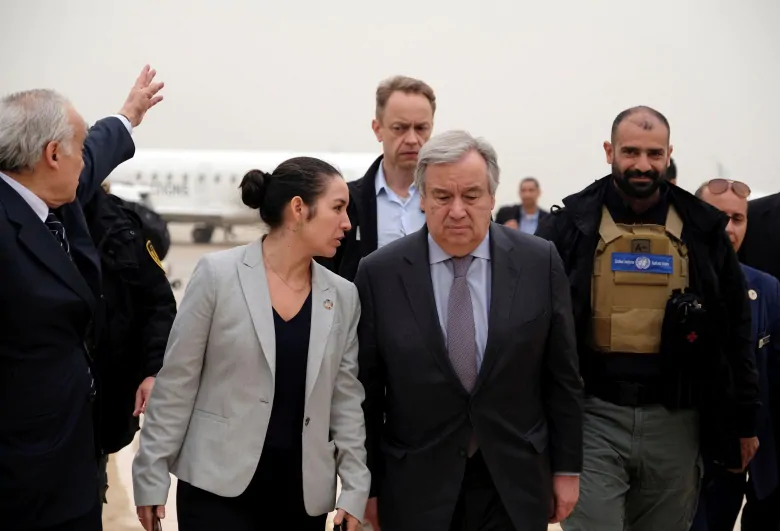
Guterres, centre, leaves the airport in Benghazi, Libya, on April 5. (REUTERS)
Oil producer
In the evening, the LNA said they had taken control of the areas of Qasr bin Ghashir and Wadi al-Rabie on the southern outskirts of Tripoli, near the airport, closed since a city battle in 2014.
It could not be independently confirmed, but a video posted online purportedly showed LNA fighters inside Qasr bin Ghashir.
They failed, however, to take a checkpoint about 30 kilometres west of the capital in a bid to close the coastal road to Tunisia. An LNA-allied armed group withdrew overnight from so-called Gate 27, leaving it abandoned in the morning, a Reuters reporter said.
In another setback, forces allied to Tripoli took 145 LNA fighters prisoner in Zawiya, west of Tripoli, a western commander, Mohamed Alhudair, told Reuters. An LNA source confirmed 128 had been captured. Sixty vehicles had also been seized, Alhudair said.
Meanwhile, armed groups allied to the UN-backed Tripoli government moved more pickups mounted with machine-guns from the coastal city of Misrata to Tripoli to defend it against Haftar’s forces.
Guterres, who spent Thursday night in the heavily fortified UN compound in a Tripoli suburb, flew to Benghazi and drove to Haftar’s base, witnesses said.
He earlier went to Tobruk, another eastern city, to meet Aguila Saleh, president of the House of Representatives, which is also allied to Haftar.
“My aim remains the same: avoid a military confrontation,” Guterres earlier said on Twitter.
The offensive is a setback for the United Nations and Western countries trying to mediate between Sarraj and Haftar, who met in Abu Dhabi last month to discuss a power-sharing deal.
The conference the United Nations wants to organize is meant to forge agreement on a roadmap for elections to resolve the prolonged instability in Libya, an oil producer and transit point for refugees and migrants trekking across the Sahara in an attempt to reach Europe.
Emergency meeting called
Haftar enjoys the backing of Egypt and the United Arab Emirates, which see him as a bulwark against Islamists and which have supported him militarily, according to UN reports.
The UAE, however, joined Western countries in expressing its deep concern about the fighting.
Germany called an emergency meeting of the UN Security Council due to the military escalation.
Russia said it was not helping Haftar’s forces and that it supported a negotiated political settlement that ruled out any new bloodshed.
Tunisia has tightened control over its border with Libya in response to the renewed conflict, the defence ministry said.
Former colonial power Italy, which lies across the Mediterranean from Libya and has been a destination for migrants fleeing the chaos at home, was very worried by the turn of events, Italian Deputy Prime Minister Matteo Salvini said.
“We need to throw water on the fire, not petrol on the fire. I hope that people, acting out of economic or business self-interest, are not looking for a military solution, which would be devastating,” Salvini said.