Driver training facilities are bustling as truck and bus drivers try to meet the new qualifications introduced by the province in October.
As of March 1, Mandatory Entry-Level Training [MELT] is required for all new Class 1 and 2 commercial drivers.
The training is also required for anyone who got their Class 1 or 2 after Oct. 10, 2018. Drivers who got their licences before that date are not required to take it.
This week, the provincial government announced it is extending the deadline for farmers and farm workers to get the training. They can apply for an extension to the MELT requirements until Nov. 30, 2019.
All the changes have the phones ringing off the hook at driver training facilities.
“There has been a rush, we’ve been very busy since October training Class 1 drivers,” said Dale Francis, president of Capilano Truck Driver Training Institute in Edmonton.
“Those people [in the group] from October until March 1 are slated for re-examination and verification,” Francis said Thursday.
And if they don’t pass, there are consequences.
“If they fail their re-examination post-March 1st, then they will be returned to their previous class of licence,” Francis said.
There is a cost to the training, in both time and money. The provincial government says training schools can charge up to $10,000 for Class 1 MELT and $5,000 for Class 2-S MELT.
Class 1 MELT requires 113 hours to complete while Class 2 is 53.5 hours.
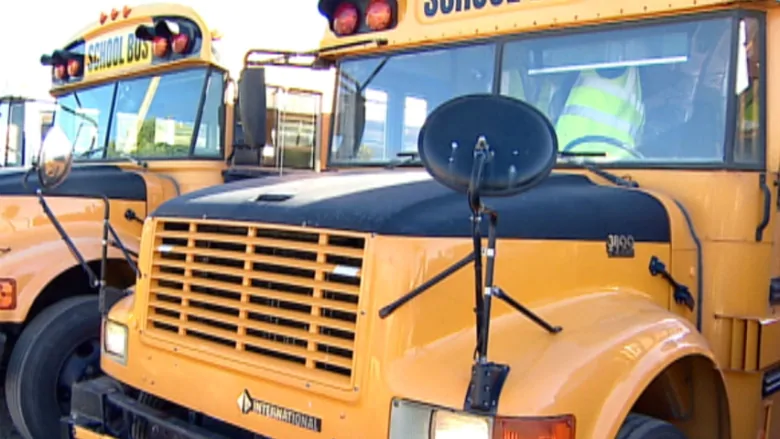
Class 2 includes school bus drivers and that has the Alberta School Boards Association concerned.
“This will cause a shortage of bus drivers and maybe spares, and put a strain on school boards abilities to get students to school,” said ASBA president Lorrie Jess. “But our biggest concern is that we would like it to be funded.”
The Alberta School Boards Association is concerned that new mandatory and costly training for bus drivers could cause shortages. (CBC)
Jess told CBC News the safety of students is paramount. The ASBA isn’t against the training but would like some assistance with the cost.
“It’s not funded and so some school boards may be forced to use funds allocated for the classroom to compensate for the additional requirement, the additional cost,” she said, adding that there was no consultation with school boards prior to implementation.
Jess said she’s hopeful the government will do something to ease the pinch, much like it did for farmers by providing an extension to meet the requirements.
Humphrey Bannack, a board member with the Alberta Federation of Agriculture, believes it would have been a tough year ahead for farmers without the extension.
“They’re going to start to hit the fields here on the 15th of April and it’s going to be a challenge to try to find class 1 drivers to meet the demand for this year so the move by the government … is much appreciated.”
The cost of the additional training could deter seasonal farm workers unless they have another driving job, said Bannack.
Still, he is in favour of anything that makes Alberta roads safer.
“When I’m heading out on the road for a 200-kilometre drive with my with my big truck and trailers, I truly believe that I should be under the same rules as every other operator out there on the road with a licence,” Bannack said.
But he questions whether it’s needed for those working close to home.
“Our concern is that short haul we have from the field to the farm and from the farm to the field,” he said.
“In the spring that’s a 30- or 40-kilometre radius. We’re on familiar roads, going predominantly lower speeds.”
Bannack would like to see an exemption or different requirements for those who don’t need to drive long distances on major highways.
Both the AFA and the ASBA continue to the lobby the province for changes that will make the new requirements more manageable.