U.S. Department of Homeland Security head Kirstjen Nielsen is set to testify Wednesday at a House of Representatives committee hearing and is expected to be pressed about the Trump administration’s declaration of a national emergency at the border, as well its controversial policy of separating children from adults who cross into the U.S. between ports of entry.
Nielsen, the homeland security secretary, will appear before the House homeland security committee in testimony that had been sought by Democrats since they gained control of the chamber in the November midterm elections.
Nielsen engendered controversy last year after denying the government was separating migrant children from their families. Her denials came even weeks after then Attorney General Jeff Sessions announced in April 2018 that adults who crossed between ports of entry would be arrested and recommended for prosecution for illegally crossing, which is a misdemeanour, with their children held at separate facilities, many run by for-profit private companies.
The policy was panned by Democrats and some Republicans and rescinded by Donald Trump via executive order, but a flurry or lawsuits resulted. Previous congressional hearings have painted a picture of confusion and chaos at the border, with myriad agencies with a stake in the process — including Homeland Security and the Department of Health and Human Services — not properly tracking who had been separated and or instituting a process on how to eventually reunite them.
Illinois Democrat Lauren Underwood, a member of the committee, said on social media on Tuesday that she expected “real answers” from Nielsen about the department’s policies, “especially those targeting families and children at the border.”
As Vice Chair of the House Homeland Security Committee, tomorrow I will question and hold <a href=”https://twitter.com/SecNielsen?ref_src=twsrc%5Etfw”>@SecNielsen</a> accountable for the policies enacted by her department, especially those targeting families and children at our border. I expect real answers.
—@LaurenUnderwood
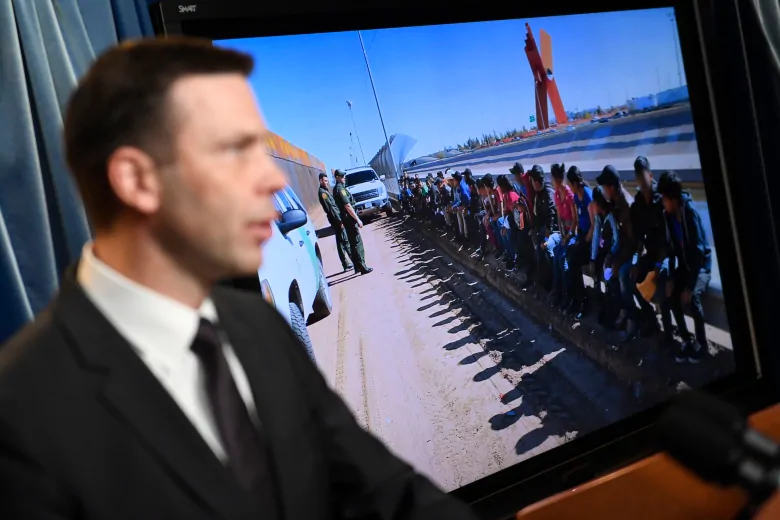
Nielsen will likely point to a report from Customs and Border Protection released Tuesday that indicated more than 76,000 migrants crossed the U.S.-Mexico border in February, more than double the number from the same period last year. Most were families coming in ever-increasingly large groups — there were 70 groups of more than 100 people in the past few months, and they cross illegally in extremely rural locations with few agents and staff. There were only 13 large groups during the previous budget year, and only two the year before.
The system “is well beyond capacity, and remains at the breaking point,” U.S. Customs and Border Protection Commissioner Kevin McAleenan said during a news conference Tuesday.
U.S. Customs and Border Patrol Commissioner Kevin McAleenan speaks during a news conference in Washington. Officials expressed alarm at the recent uptick in numbers and the changing demographics of those arriving at the southern border, including more families and unaccompanied children. (Susan Walsh/Associated Press)
The new figures reflect the difficulties President Donald Trump has faced as he tries to cut down on illegal immigration, his signature issue. But it could also help him make the case that there truly is a national emergency at the border — albeit one built around humanitarian crises and not necessarily border security. The Senate is expected to vote next week and join the House in rejecting his national emergency declaration aimed at building border walls, but Trump would almost certainly veto the measure and the issue is likely to be settled in the courts.
But critics argue the administration’s own policies are exacerbating the situation. Border officials have been limiting, or “metering,” the numbers who can submit an asylum claim at ports of entry, with the unintended consequence some then attempt to cross between border points.
Recent increase, but not historically high
As well, the number of apprehensions is far below the totals of the 1990s and early 2000s. The number of apprehensions was about 400,000 over the last budget year, for example, compared with the high of 1.6 million in 2000.
Nielsen can also be expected to be asked about recent deaths of migrants in custody, including two children. Customs and Border Protection has said in the wake of the deaths it has stepped up medical screenings. The agency also announced sweeping changes including more rigorous interviews as migrants come into the system.
And McAleenan said a new processing centre would be built in El Paso, Texas, that will be better suited to manage families and children and handle medical care concerns — but it’s not a permanent solution.
“While our enhanced medical efforts will assist in managing the increased flows, the fact is that these solutions are temporary and this solution is not sustainable,” he said.

The administration’s child separation policy led to widespread protests last year, including at Logan Square in Philadelphia on June 30. (Tim Tai/The Philadelphia Inquirer via AP)
Those apprehended used to be mostly single men from Mexico, but are now mostly families from Central America — since October, more than 130,000 families have been apprehended between ports of entry. From October through September 2018, about the same number of families was apprehended at the U.S.-Mexico border. Tens of thousands of children illegally cross the border alone. While single men used to evade capture, the families are seeking out agents.
Border officials said the large families groups are creating opportunities for smugglers because attention is diverted to the large groups. Border officials say they worry they’re spending too much time on migrant care and not enough on security.
To ease the burden, the administration has convinced Mexico to take in a few dozen migrants per day who are awaiting an answer to their U.S. asylum claims. A spokesperson for Mexico’s Foreign Relations Department said last month the country didn’t agree with the move, but would accept the migrants.
Mexico’s ministry has said the actions taken by the Mexican and U.S. governments do not constitute a “safe third-country” scheme, where migrants would have to request U.S. asylum while in Mexico. Such an agreement exists between the U.S. and Canada, but Mexico’s ability to guarantee migrant safety are doubted given the country’s issues with drug cartel and gang violence.
The U.S. government says migrants will be turned away with a “notice to appear” in immigration court. They will be able to enter the United States for their hearings, but will have to live in Mexico in the interim. If they lose their cases, they will be deported to their home countries.

U.S. Homeland Security Secretary Kirstjen Nielsen testified last year on Capitol Hill on Washington. Nielsen took over the role in December 2017 from John Kelly. (Joshua Roberts/Reuters)
Trump has derided the process often followed by previous administrations, where those waiting on a decision for their asylum claim were released into the community. Many stayed on illegally in the U.S., staying in the country after an adverse ruling on their case or not showing up at all for their immigration court date, a process that can take months or even years.
The migrant caravans that have travelled from Central America over the past two years have agitated Trump and seen him mobilize the U.S. military to beef up border security.
Trump has made the need for a wall along the southern border a signature part of his presidential campaign and time in office, angling for funds during a month-plus partial government shutdown that began in mid-December.