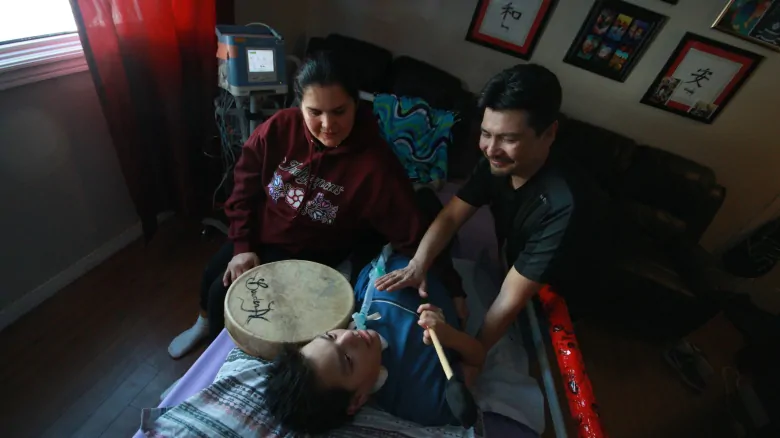
It’s the little things in life that make River Lapensee smile these days — watching his favourite cartoons, clapping his hands and being able to still proudly play his drum from his bed.
The 12-year-old boy from Pukatawagan, Man., is dying.
“We don’t know for sure when this is going to happen but we know for sure it’s going to happen,” says River’s dad Robert Lapensee, before giving his son a kiss at the boy’s new Winnipeg home.
Lapensee and River’s mother Selena Castel are convinced their son, who is living with chronic obstructive pulmonary disease (COPD) and several other medical issues, was poisoned by mould at their community’s daycare inside the Mathias Colomb Cree Nation’s school.
The boy relies on a machine to breathe, is fed through a feeding tube and requires extensive around-the-clock care by his parents and health care aides.
While they also had some occasional mould inside their home on the reserve, River’s parents say ever since their boy started going to daycare when he was three months old, he would get sick with flu-like symptoms.
They’d bring him to the local nursing station where their son would be prescribed antibiotics over and over again until summer came.
“In the summer times when school was out, he was great. We never, we didn’t take him to the nursing station, he didn’t require to be seen, breathing was good and then school started up again and then he started getting sick after the first few days going to school,” says Lapensee.
Robert Lapensee and River’s mother Selena Castel are convinced their son was poisoned by mould at their community’s daycare inside the Mathias Colomb Cree Nation’s school. A doctor not familiar with his specific file says the symptoms are not a match. (Tyson Koschik/CBC)
Eventually in 2008, River — who lives with cerebral palsy, autism, osteoporosis, scoliosis and has neurological problems — was diagnosed with cryptosporidium, a parasite his parents believe he contracted through contaminated drinking water. Their son’s condition continued to deteriorate and reached a critical level in 2016 when the boy could no longer walk.
A report written last month by Winnipeg mould and asbestos remediation company Breathe Easy Eco Solutions shows elevated levels of mould in three classrooms, a resource room and a hallway inside Mathias Colomb’s Sakastew School, which was shut down for several weeks starting in December due to mould concerns.
“We realized the urgency of getting this done was quite high. It’s a school and there’s sick kids and, you know, the staff themselves were concerned,” said Steve Greene, co-owner of the company that cleaned up the mould.
Castel says about a month ago one of River’s doctors told her that part of her son’s illness could have been caused by an environmental sickness but that wasn’t a definitive conclusion.

Saskatew School in Mathias Colomb Cree Nation was closed in December for mould remediation. (sakastewschool.wixsite.com)
“Some of his respiratory symptoms could be exacerbated by mould but all of his symptoms can’t be explained by mould,” adds Dr. Anna Banerji, a pediatric infectious disease specialist at the University of Toronto, who has travelled extensively to First Nations across Canada.
Banerji, who spoke generally about the case because she was not personally familiar with the boy’s file, says not having access to safe drinking water, being malnourished due to poverty and overcrowding in First Nations housing can all exacerbate a compromised immune system.
But from mould, symptoms tend to be more like “wheezing, shortness of breath, runny nose mainly respiratory, can make eczema worse — things like that,” she said.
Greene said from his decades of experience, mould affects every person differently but generally once someone is away from it, they get better.
“We have customers who are exposed to the slightest amount of mould and they are absolutely floored by it. I frequently talk to husbands and wives who have different levels of sensitivity … and I teach them tolerance. It’s not something you can see but it’s something you can feel and especially when the onset of the symptoms of it are similar to asthma.”
Castel and Lapensee have been through losing a child before. Two of their sons died in a house fire on their reserve with two other relatives in 2008. But Lapensee says his son’s condition has created a new kind of pain.

River Lapansee loves to watch his favourite cartoons and play his drum. (Tyson Koschik/CBC)
“It’s totally different to see your son dwindling away as opposed to an accident where they died and you feel the pain but this is the pain you’re going through every day, every day pain, every day emotions — looking at him knowing maybe this is the day he’s going to have a heart attack on us.”
Lapensee says if River has a heart attack, they won’t be able to help him.
“If he does have a heart attack on us we can’t revive him it would literally crush him. We can’t give CPR to him, we crush him and cause more pain. So literally we just have to watch him succumb … we can’t do nothing. We’re sitting here doing nothing watching my boy diminish.”
Castel blames the federal government in part for having mould-prone houses and schools on Canadian reserves. “There shouldn’t have been no excuses for the school. A public school, no excuses,” she says.
“I think the state of housing is abysmal and I think it’s a human rights violation,” adds Banerji, who wants to see national basic housing standards developed.
“If Canadians knew how bad it is for many Indigenous communities, I think they would be ashamed.”

‘We don’t know for sure when this is going to happen but we know for sure it’s going to happen,’ says River’s dad Robert Lapensee, before giving his son a kiss at the boy’s new Winnipeg home. (Tyson Koschik/CBC)
CBC has been trying to get in touch with Mathias Colomb Cree Nation Chief Lorna Bighetty since Saturday but our calls have not yet been returned.
Requests for comment to the school’s education director went unanswered and an email to Indigenous Services Canada Sunday wasn’t immediately returned.
This week, the federal government and Ontario First Nations leaders signed an interim framework agreement to begin to repair and replace dozens of homes in a remote Indigenous community in northern Ontario. More than $10 million was pledged to Cat Lake First Nation, which declared a state of emergency last month over dangerously inadequate, mould-infested housing.
Watch Indigenous Services Minister Seamus O’Regan explain the agreement: