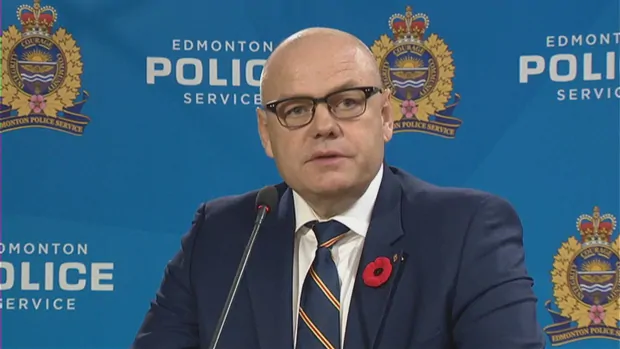
Edmonton’s 23rd police chief is being lauded as a visionary leader “uniquely equipped” to lead the Edmonton Police Service.
Dale McFee is being sworn in Friday afternoon at City Hall. Mayor Don Iveson and Justice Minister Kathleen Ganley will speak during the ceremony, and McFee will answer questions from reporters afterwards.
“He’s uniquely equipped and I’d say unparalleled in Canada in terms of the experiences and the knowledge base that he comes into this role in. You just don’t see this in Canada,” said Cal Corley, CEO of the Saskatchewan-based Community Safety Knowledge Alliance.
“But more than just being a visionary leader, [McFee] is one that has a proven track record of being able to execute on strategy,” said Corley, who has worked closely with McFee over the past decade.
McFee, who is Métis, is originally from St. Albert. At 16, he was recruited to play for the Prince Albert Raiders hockey team. He went on to leave his mark in Saskatchewan.
Most recently McFee, 53, served as Saskatchewan’s deputy minister of corrections and policing.
Prior to that, he was chief of the Prince Albert Police Service, where he is credited with increasing Indigenous representation among officers to 38 per cent.
He has served as the President of the Canadian Association of Chiefs of Police.
McFee also has a background as an entrepreneur and once owned A&W franchises.
Corley pointed to McFee’s time as deputy minister spent in correctional facilities or on the street with parole officers “as an indication of a guy who goes deep, who wants to understand” and develops a relationship with his people.
McFee got ahead of the issue of the cost of policing combined with finite resources against exceeding demands in a few ways, said Corley.
One of McFee’s best known initiatives is the Hub model — a cost-effective, multi-agency crime-fighting model which has spread to 140 locations across North America.
Chad Nilson, a scholar at the University of Saskatchewan’s Centre for Forensic Behavioural Science and Justice Studies, has worked closely with McFee on the Hub.
He said McFee has pushed policing on an international level to places few thought it could go.
“We’re talking about having everyone from chiefs down to frontline officers and new recruits thinking differently about the role of police in society and the way in which the community as a whole can take ownership over safety and well-being,” Nilson said.
He said McFee has the courage to stand up and say what’s wrong with policing and then work collaboratively with the community to fix it.
“He recognizes that disease and education and homelessness and poverty and family violence all are interrelated and those composite risk factors are the business of a police chief.”
Nilson said McFee is “a tremendous win for the citizens of Edmonton” but his next chapter also presents a great opportunity for the rest of Canada.
“We’re talking about a police leader who we will be reading about 100 years from now, and he’s going back to the helm to lead a lead a police service to teach us things about social innovation.
“For some unexplained reason, Saskatchewan is paying the price for Los Angeles taking Gretzky from Edmonton many years ago.”