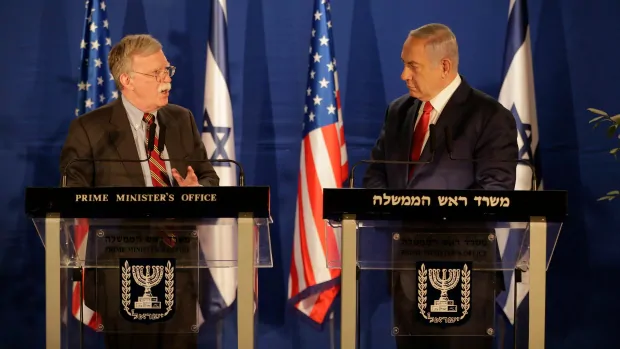
U.S. troops won’t leave northeastern Syria until ISIS militants are defeated and American-allied Kurdish fighters are protected, a top White House aide said Sunday, marking the first public confirmation that the troop drawdown abruptly announced last month by President Donald Trump has been slowed.
During a visit to Israel, U.S. national security adviser John Bolton said there is no timetable.
However, Trump said in his Dec. 19 withdrawal announcement that U.S. forces “have defeated ISIS in Syria, my only reason for being there during the Trump Presidency,” and added in a video posted to Twitter, “Now it’s time for our troops to come back home.”
After historic victories against ISIS, it’s time to bring our great young people home! <a href=”https://t.co/xoNjFzQFTp”>pic.twitter.com/xoNjFzQFTp</a>
—@realDonaldTrump
During a visit to Israel, Bolton said the U.S. would pull out only after its troops had rooted out what’s left of the Islamic State in Iraq and Syria and after the administration had reached an agreement with Turkey to protect Kurdish militias who have fought alongside Americans against the extremists.
In a tweet sent Dec. 31, Trump appeared to pull back on his earlier words, saying, “ISIS is mostly gone, we’re slowly sending our troops back home to be with their families, while at the same time fighting ISIS remnants.”
If anybody but Donald Trump did what I did in Syria, which was an ISIS loaded mess when I became President, they would be a national hero. ISIS is mostly gone, we’re slowly sending our troops back home to be with their families, while at the same time fighting ISIS remnants……
—@realDonaldTrump
And officials said at the time that while many details were yet to be finalized, they expected American forces to be out by mid-January.
“I think this is the reality setting in that you got to plan this out,” said Republican Sen. Lindsey Graham, telling CBS’s Face the Nation on Sunday that “the bottom line here is we want to make sure we get this right, that ISIS doesn’t come back. And I applaud the president for re-evaluating what he’s doing. … He has a goal in mind of reducing our presence. I share that goal. Let’s just do it smartly.”
Trump’s decision last month drew widespread criticism from allies, led to the resignation of U.S. Defence Secretary Jim Mattis and raised fears over clearing the way for a Turkish assault on the Kurdish fighters. Turkey considers the Syrian Kurdish People’s Protection Units, or YPG, a terrorist group linked to an insurgency within its own borders.
“There are objectives that we want to accomplish that condition the withdrawal,” Bolton told reporters in Jerusalem. “The timetable flows from the policy decisions that we need to implement.”
He was to be in Turkey on Monday, accompanied by Gen. Joseph Dunford, chairman of the U.S. Joint Chiefs of Staff, for talks with government officials.
Bolton said the U.S. wants its Kurdish allies in Syria protected from any planned Turkish offensive — a warning to be delivered to Turkish President, Recep Tayyip Erdogan.
“We don’t think the Turks ought to undertake military action that’s not fully co-ordinated with and agreed to by the United States,” Bolton said. He said that in upcoming meetings with Turkish officials, he will seek “to find out what their objectives and capabilities are and that remains uncertain.”
Bolton said Trump has made it clear he would not allow Turkey to kill the Kurds. “That’s what the president said, the ones that fought with us.”
Bolton said the U.S. has asked the Kurds to “stand fast now” and refrain from seeking protection from Russia or Syrian President Bashar al-Assad’s government. “I think they know who their friends are,” he said, speaking of the Kurds.
Jim Jeffrey, the special representative for Syrian engagement and the newly named American special envoy for the anti-Islamic State coalition, is to travel to Syria this coming week in an effort to reassure the Kurdish fighters that they are not being abandoned, Bolton said.
Turkey’s presidential spokesperson called allegations that his country planned to attack the U.S.-allied Kurds in Syria “irrational,” and said Turkey was fighting terrorism for national security.
In comments carried by Turkey’s official Anadolu news agency, Ibrahim Kalin said the Kurdish fighters oppressed Syrian Kurds and pursued a separatist agenda under the guise of fighting ISIS. “That a terror organization cannot be allied with the U.S. is self-evident,” he said.
Rep. Adam Smith, incoming chairman of the House armed services committee, told ABC’s This Week that the conditions raised by Bolton were “obvious,” and Smith criticized the conflicting messages from the Trump administration.
“We don’t want ISIS to rise again and be a transnational terrorist threat and we don’t want our allies, the Kurds, to be slaughtered by Erdogan in Turkey,” said Smith, a Democrat.
Bolton said U.S. troops would remain at the critical area of al-Tanf, in southern Syria, to counter growing Iranian activity in the region. He defended the legal basis for the deployment, saying it’s justified by the president’s constitutional authority.
The U.S. is also seeking a “satisfactory disposition” for roughly 800 ISIS prisoners held by the U.S.-backed Syrian opposition, Bolton said, adding talks were ongoing with European and regional partners about the issue.
Bolton met with Israeli Prime Minister Benjamin Netanyahu on Sunday to discuss the pace of the U.S. drawdown, American troop levels in the region, and the U.S. commitment to push back on Iranian regional expansionism.
Bolton was expected to explain that some U.S. troops based in Syria to fight ISIS will shift to Iraq with the same mission and that the al-Tanf base would remain.
He also was to convey the message that the United States is “very supportive” of Israeli strikes against Iranian targets in Syria, according to a senior administration official, who was not authorized to publicly discuss Bolton’s plans before the meetings and spoke on condition of anonymity.