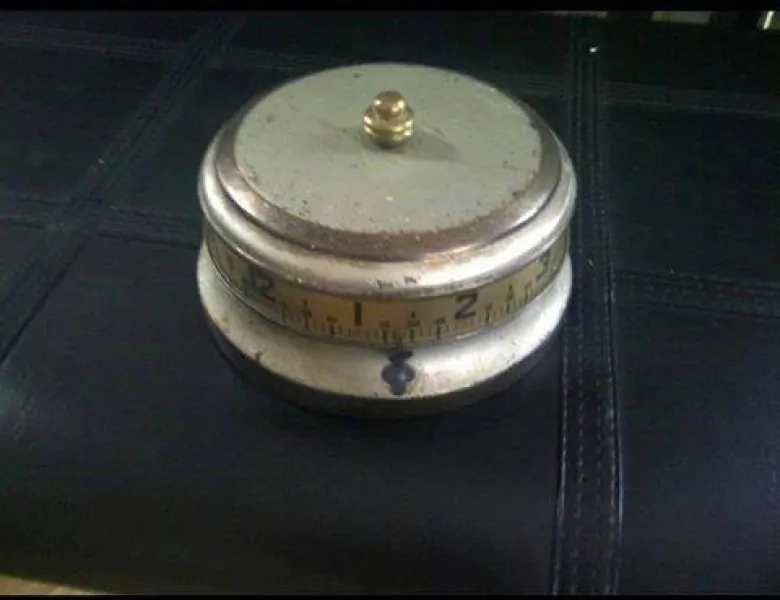
It’s a candy bar moniker that has stood the test of time — and the Alberta descendants of the Maritime man who named it still have the clock to prove it.
Fans of Eat-More, an iconic Canadian delight consisting of dense, dark toffee and peanuts, can thank the late Angus B. MacDonald for the name we now associate with “a good, long chew.”
In the early 1930s, MacDonald won a naming contest that had been advertised in the local newspaper. The grand prize was an art deco-style clock still cherished by his family today.
MacDonald’s claim to fame has been part of family lore for generations but recently his great-granddaughter started delving into the sweet piece of family history.
“Everybody kind of knew that he named the chocolate bar and got the clock,” said Chantelle Hoisington, who now lives in Whitecourt, Alta.
The clock is fashioned to look like a measuring tape.
“It has a dial, you have to turn it kind of like a music box so you would have to wind it every so often,” Hoisington said.
The clock won by Angus B. MacDonald from the Lowney company in the 1930s is shaped like a tape measure and needs to be wound like a music box. (Facebook)
MacDonald lived in New Waterford, on the Nova Scotia island of Cape Breton. Many of his descendants live in Alberta.
The clock is here, too, holding a place of honour in the family home in Rocky Mountain House.
Until the early 2000s, it still worked.
“My mother, she just hasn’t wound it in a really long time,” Hoisington said in an interview with CBC Radio’s Edmonton AM.
“I think it was working but it started going a little bit awry … She’s nervous to break it.”
The clock was given to MacDonald by the Lowney company, which produced Eat-More bars before Hershey Canada took over production in 1987.
The ticking piece of candy Canadiana did fall out of family ownership for a short while when Hoisington’s great-grandmother gave it to a neighbour back in Cape Breton many years ago.
The clock had been gathering dust in her attic for years and the decision to give it away came when she moved to a smaller home after MacDonald’s death in 1938.
“When great-grandma got older, she moved into a smaller home and the neighbour, Mr. Sampson, ended up with the clock,” Hoisington said.
She said her father remembered the clock and often wondered where the family heirloom had wound up.
It was returned to the family in the late 1990s when Hoisington’s mother went to visit Sampson in New Waterford.
“My mom bought it back for $80 and gave it to my dad for a Father’s Day gift.
“[Sampson] was happy to return it to the family.”