The city issued 144,161 fewer photo or laser radar tickets last year compared to 2016, according to the latest numbers from the city.
That’s about a 27-per-cent drop.
City statistics show the number of photo radar tickets issued in 2016 was 522,780. The number has been dropping each year since, with 2017 at 458,508 tickets issued and last year’s tally at 378,619.
“It’s a positive story that we’re seeing a reduction in overall number of tickets,” said Gerry Shimko, executive director of the Office of Traffic Safety.
“The research is pretty clear that over time, drivers will adjust accordingly and will change their behaviours in a more positive way, which contributes to greater community safety.”
Shimko attributes the drop in the number of tickets in part to drivers getting the message about speeding.
“It’s just a general, good behavioural change that we’re seeing through education and enforcement,” Shimko said.
He added that no new photo enforcement vehicles were added to the city’s fleet last year.
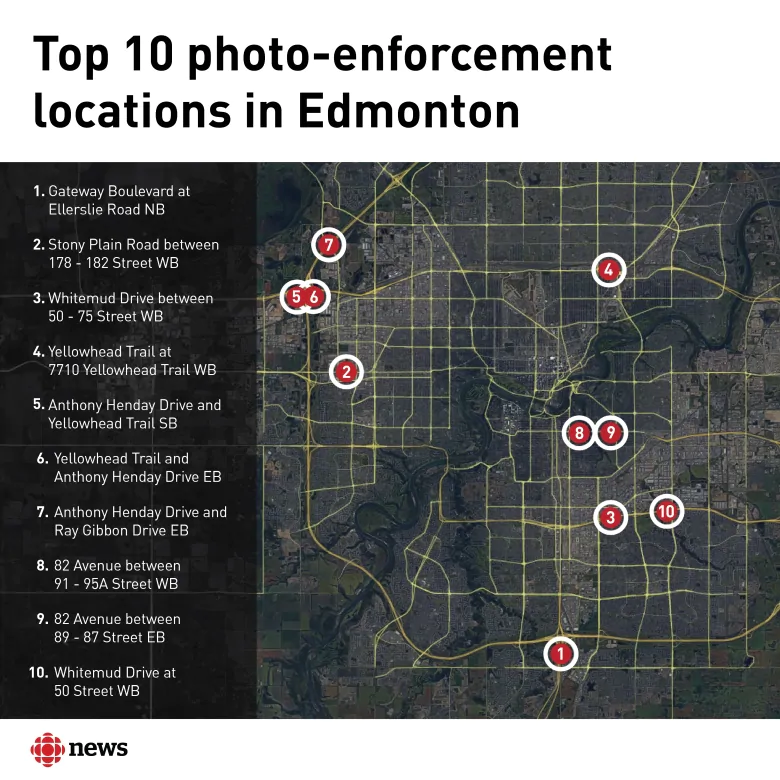
This map shows the top 10 enforcement sites by tickets issued in 2018, according to the City of Edmonton. (CBC)
It’s not the same story at intersections equipped with red-light cameras, where 138,298 drivers were caught speeding in 2018, about three per cent more than in 2017.
More drivers were also nabbed for running red lights in those intersections, 15,523 last year up from 13,793 in 2017.
That jump is partly because the city added seven new red-light cameras, with more to be set up later this year, Shimko said.
But fewer speeders overall means less ticket-generated revenue for traffic safety programs, he said.

Gerry Shimko, with the Office of Traffic Safety, attributes the drop in the number of tickets in part to drivers getting the message about speeding. (Trevor Wilson/CBC)
Revenue generated from tickets does not go into a general revenue fund, but is distributed among traffic safety programs, according to city officials.
The city’s data shows revenue from photo radar and intersection cameras generated almost $42 million in 2018, a drop from the $51.8 million reported in 2016 and the $51.3 million collected in 2017.
City administration will present its plan on dealing with decreasing photo radar revenue to city council later this year.
Traffic-related fatalities
Despite the decrease in speeding infractions, the city is still far from its goal of zero traffic-related fatalities.
Vision Zero is the city’s long-term goal to reach zero traffic-related major injuries and fatalities by 2032.
Last year, preliminary numbers show 20 people were killed in traffic-related fatalities compared to 27 in 2017, according to numbers provided by Shimko.
“Every one fatality that we hear about, always causes us consternation,” he said. “Another family that has to go through that tragic loss is generally preventable.”