Two bills to end the partial government shutdown in the United States — one put forward by the Republicans and one previously passed by the Democratic-majority House of Representatives — both failed this afternoon in votes in the Senate.
In an embarrassment to U.S. President Donald Trump that could weaken his position in negotiations, the Democratic proposal got one more vote than the Republican plan in the Republican-dominated Senate. There were six Republican defectors, including freshman Senator Mitt Romney, who’s clashed periodically with the president.
Each bill needed 60 votes to pass. The Republican bill got 51 votes in favour, 47 against. The Democrats’ plan received 52 in favour, 44 against.
In the hours before the vote, signs emerged that lawmakers might consider new ideas for ending the 34-day shutdown, which was triggered by Trump’s demand for money to fund his long-promised wall on the U.S.-Mexico border.
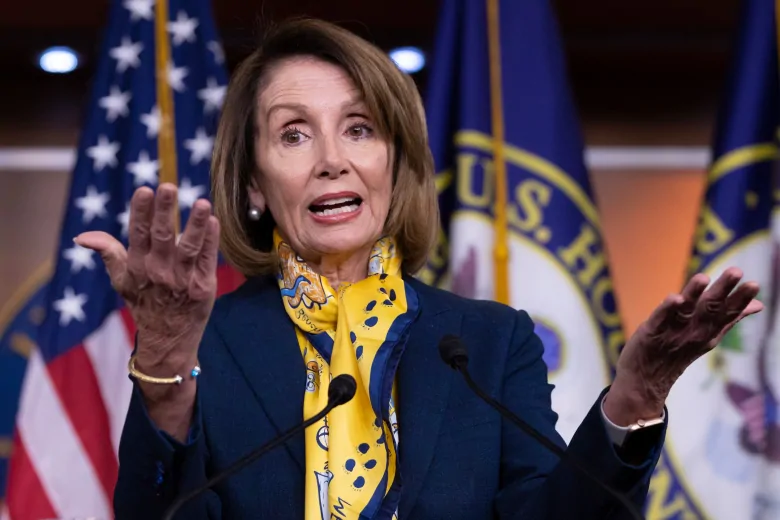
House of Representatives Speaker Nancy Pelosi, a Democrat, told reporters she was willing to meet with the Republican president to discuss the issue.
Speaker of the House Nancy Pelosi said Thursday she was willing to meet with the Republican president to discuss the issue. (J. Scott Applewhite/Associated Press)
Her comment came one day after she announced that Trump’s State of the Union speech in the House chamber, scheduled for Tuesday, would not occur until the shutdown ended, despite the president’s plans to come. Trump, who considered giving the speech at another venue, conceded late on Wednesday and said he would deliver the speech in the House in the “near future.”
Trump wants $5.7 billion for the border barrier, opposed by Democrats, as part of any legislation to fund about a quarter of the federal government.
Republican Senator Lindsey Graham, who is in regular contact with Trump, told reporters there were bipartisan efforts in the Senate to win the president’s backing for a three- to four-week government funding bill that would open shuttered agencies while border security negotiations take place. He urged Pelosi to back the efforts in the House.
The longest such shutdown in U.S. history has left 800,000 federal workers, as well as private contractors, without pay and struggling to make ends meet, with the effects on government services and the economy reverberating nationwide.

Senate judiciary committee chairman Lindsey Graham has been in regular communication with Trump throughout the shutdown. (J. Scott Applewhite/Associated Press)
U.S. Commerce Secretary Wilbur Ross on Thursday urged furloughed federal workers to seek loans to pay their bills while adding in a CNBC interview that he couldn’t understand why they were having trouble getting by.
Pelosi denounced the comments.
“Is this the ‘Let them eat cake’ kind of attitude? Or ‘Call your father for money’? Or ‘This is character building for you’?” Pelosi asked at a news conference.
She said she did not understand why Ross would make the comment “as hundreds of thousands of men and women are about to miss a second paycheque tomorrow.”
Trump responded to Pelosi in a tweet, without mentioning Ross.
Nancy just said she “just doesn’t understand why?” Very simply, without a Wall it all doesn’t work. Our Country has a chance to greatly reduce Crime, Human Trafficking, Gangs and Drugs. Should have been done for decades. We will not Cave!
—@realDonaldTrump
Senate majority leader Mitch McConnell has previously said he would not consider legislation that Trump did not support. The fact that he was willing to allow a vote suggests he may be trying to persuade lawmakers of both parties to compromise.
Americans blame Trump
A Reuters/Ipsos poll last week found more than half of Americans blamed Trump for the shutdown even as he has sought to shift blame to Democrats after saying last month he would be “proud” to close the government for border security.
John Kelly, who served as Trump’s chief of staff and Homeland Security secretary, and four other former Homeland Security secretaries called the shutdown “unconscionable” in a letter to Trump and Congress, warning that some of the department’s 240,000 employees may be forced to quit and look for work elsewhere if they do not get paid.