Canada and a dozen Latin American governments have urged Venezuelan President Nicolas Maduro to abstain from being sworn in for a second term next week and cede power until new elections can be held that they say is the only way to restore democracy in the South American nation.
The strong rebuke came following a meeting Friday of high-ranking diplomats from the 13 countries, who are in Peru’s capital to discuss Venezuela’s crisis ahead of Maduro’s plans to be sworn in Jan. 10 for a second six-year term he won in elections widely condemned as illegitimate.
Mexico also partook in the meeting of the so-called Lima Group but didn’t sign the statement.
The group also called for a toughening of sanctions against Maduro’s government and expressed support for efforts to initiate proceedings against his government at the International Criminal Court.
Venezuela says countries taking orders from Trump
Maduro has disavowed the group’s recommendations in the past and his foreign minister on Friday accused the countries of taking orders from U.S. President Donald Trump.
Earlier Friday, Venezuela’s Foreign Minister Jorge Arreaza accused the group of countries was taking orders directly from U.S. President Donald Trump, who has been frequently … of spearheading an economic war against the socialist country.
“What a display of humiliating subordination!” Arreaza said on Twitter.
A once-wealthy oil nation, Venezuela is in crisis after two decades of socialist rule, marked by hyperinflation making it difficult for people to afford scarce food and medicine. An estimated 2.3 million Venezuelans have migrated from their country since 2015, according to the United Nations.
The Lima Group formed more than a year ago to advocate for a solution to Venezuela’s crisis that threatens regional instability.
Immediately following Maduro’s May 20 re-election, the coalition announced that it refused to recognize the results, decrying the vote as failing to meet “international standards of a democratic, free, just and transparent process.”
Canada, Argentina, Brazil and Mexico are among the group’s members.
Peruvian Foreign Minister Nestor Popolizio recently said his country would propose that Lima Group members break diplomatic relations with Venezuela as well as blocking members of Maduro’s administration from entering into any of the Lima Group countries.
However, the political make-up of the coalition has recently shifted, most notably in Mexico.
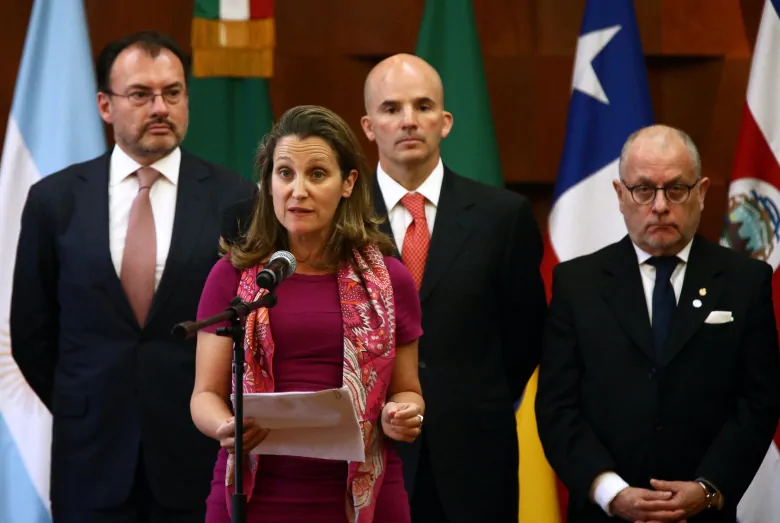
Canadian Foreign Minister Chrystia Freeland addresses reporters during a meeting of the Lima Group in Mexico City last May. The group formed last year to advocate for a solution to Venezuela’s deepening political and economic crisis, which threatens regional instability. (Edgard Garrido/Reuters)
The newly elected government of Mexican President Andres Manuel Lopez Obrador could change the former cohesion of the group. His administration has adopted a policy of non-intervention, and Maduro travelled to Obrador’s inauguration, meeting privately with the new Mexican leader.
The United States is not formally a member of the Lima Group, but Pompeo participated in the meeting via video conference.
It follows his Pompeo’s recent visit to Latin America, attending the inauguration of Brazil’s President Jair Bolsonaro and then stopping in Colombia to meet with President Ivan Duque. Both Bolsonaro and Duque signalled a united stance against Maduro’s government aligned with the United States.
Poor optics of Pompeo presence at meeting
The Trump administration considers Maduro’s government a forming “dictatorship,” sanctioning roughly 70 top officials and blocking U.S. banks from doing business with Venezuela, putting a financial strangle-hold on the cash-strapped country.
Geoff Ramsey, a Venezuela researcher at the Washington Office on Latin America, called the optics of Pompeo’s presence in Friday’s meeting “terrible.”
The Lima Group was created to showcase regional concern for the crisis among Latin American countries, he said, adding that Pompeo’s involvement furthers a perception that the U.S. has been quietly directing its moves from behind the curtains.
Rather, the coalition should push for neutral actors to open dialogues between Maduro’s government and opposition leaders, finding ways to reduce mounting international pressure and finding a peaceful resolution in Venezuela, Ramsey said.
“I think what the region needs to do now is how to be part of the solution and not part of the problem,” Ramsey said. “Isolating the government and continuing to pile on the pressure without channeling some kind of productive release hasn’t produced productive results.”