Prime Minister Justin Trudeau’s fourth first ministers meeting wrapped up in Montreal Friday with little evidence of progress on key issues plaguing Canada’s economy.
Several days of public bickering between the premiers and Ottawa over the agenda — over who talks when, who listens and which priorities should dominate — overshadowed any signs of groundwork being laid for agreement.
Ontario Premier Doug Ford initially threatened to walk out of the meeting Thursday if his demands for changes to the agenda weren’t met. But the premiers stayed put; when asked how the meetings went, Ford described them as both “fabulous” and “fantastic.”
Officials and premiers said the group had a pleasant dinner with the prime minister in a Montreal restaurant Thursday night, making it unclear whether the tough public posturing would carry over into the private meetings.
The prime minister met early Friday morning with national Indigenous leaders before the premiers joined First Nations, Inuit and Métis leaders for a larger discussion of their economic development issues.
AFN Grand Chief Perry Bellegarde says this morning meetings with the premiers was positive. Urged premiers to establish formal bilateral relationships with Indigenous leaders in their own provinces. <a href=”https://t.co/vIsnhqqgo7″>pic.twitter.com/vIsnhqqgo7</a>
—@CBCKatie
Intergovernmental Affairs Minister Dominic LeBlanc, Environment Minister Catherine McKenna, Finance Minister Bill Morneau and Canada’s ambassador to the United States, David MacNaughton, joined the group this morning for six hours of talks on economic and trade issues.
Cameras were invited into the room briefly to record opening remarks from Trudeau, who touted his government’s record on job creation and economic growth and its efforts to protect the environment.
“Pollution should not be free anywhere in Canada,” he said, as several premiers who adamantly oppose the federal carbon pricing strategy looked on. (Saskatchewan and Ontario are both challenging the federal carbon tax in court, calling it unconstitutional.)
Trudeau praised Quebec’s cap and trade system for reducing carbon emissions. Then he said the talks would address sectors “currently facing significant challenges,” citing the energy and automotive sectors specifically.
PM <a href=”https://twitter.com/JustinTrudeau?ref_src=twsrc%5Etfw”>@JustinTrudeau</a> speaking ahead of the <a href=”https://twitter.com/hashtag/fmm?src=hash&ref_src=twsrc%5Etfw”>#fmm</a> …with <a href=”https://twitter.com/fordnation?ref_src=twsrc%5Etfw”>@fordnation</a> sitting next to him he says pollution should not be free. <a href=”https://twitter.com/hashtag/cdnpoli?src=hash&ref_src=twsrc%5Etfw”>#cdnpoli</a> <a href=”https://twitter.com/hashtag/hw?src=hash&ref_src=twsrc%5Etfw”>#hw</a> <a href=”https://t.co/hgqCb6LOWQ”>pic.twitter.com/hgqCb6LOWQ</a>
—@HannahThibedeau
No ‘weirdness’ yet
Several premiers had made it clear going in that they weren’t interested in being lectured by Trudeau or any of his ministers.
A source in the room told CBC News that, at one point, New Brunswick Premier Blaine Higgs interrupted Morneau’s presentation to suggest he take questions. Morneau answered one, then carried on speaking.
Higgs later told reporters he didn’t think he was being lectured and felt positive about how things were going.
“People presented a few issues that we need to continue to work on,” Morneau told reporters, describing the ambiance as “good” and the premiers, including Ford, as “leaning in”, engaged and working constructively during his one-hour session with them.
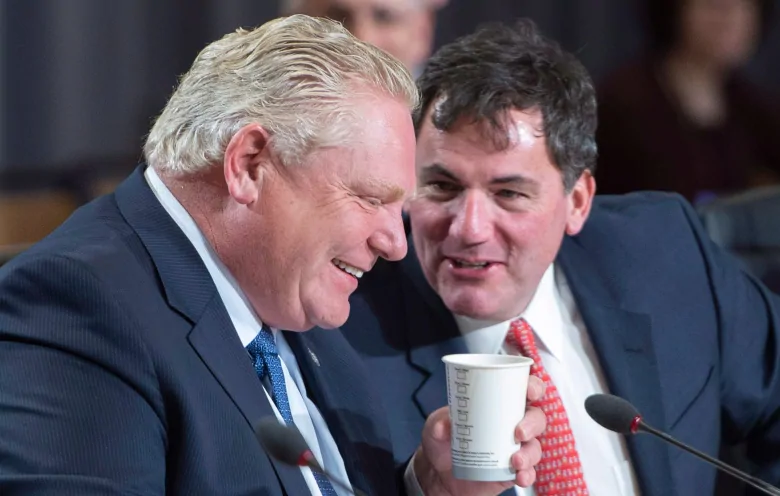
Ontario Premier Doug Ford chats with Intergovernmental Affairs Minister Dominic Leblanc at the start of the first ministers meeting in Montreal. (Paul Chiasson/Canadian Press)
When the discussion turned to energy issues, such as pipelines and the federal government’s legislation to change the environmental assessment process to approve future projects, premiers expressed the fear that the federal cabinet’s veto power will deter future investments.
Some premiers want the assessment bill dropped. Others disagree, saying the old system was worse.
Trudeau pushed the premiers to suggest other solutions to the oil crisis. The only one offered was to move more oil by rail, a source said.
Another source said there hadn’t been any “weirdness” yet around the table and talks were productive. McKenna reportedly kept her own remarks to the premiers brief when the discussion on environmental issues began.
Close to alcohol announcement?
If any progress is made, it could be on interprovincial trade barriers, which was intended to be the original focus for this gathering. But it’s not clear if the premiers have done much on this file since they last met in July.
Quebec was chairing the committee on internal trade before the October election that replaced Philippe Couillard’s Liberals with a Coalition Avenir Québec government under Premier François Legault; a new minister is now in the chair. Efforts to harmonize regulations for the trucking industry have moved forward, but on other files — such as liberalizing alcohol sales — the provinces seem to be digging in their heels.

Quebec Premier Francois Legault (left) speaks to his Nova Scotia counterpart Stephen McNeil. As talks got underway Friday, McNeil announced several concrete steps his province had taken to cut interprovincial trade barriers. (THE CANADIAN PRESS)
Nova Scotia Premier Stephen McNeil, one of two premiers tasked with the alcohol file coming out of the premiers’ talks last July, issued a news release outlining several moves his province was making to facilitate internal trade, including removing personal exemption limits on alcohol transported into Nova Scotia for personal consumption.
The premiers tried but failed to draft a joint announcement on alcohol exemption limits last summer. Manitoba Premier Brian Pallister, the other premier working with McNeil on trade issues, said nine provinces are ready to end these exemption limits, and they’re hoping to get agreement at the first ministers table to say publicly who doesn’t want to move ahead with it.
“I didn’t come all this way to walk out of a meeting,” Pallister said. “If we have too many priorities, we won’t get anything done. And on the trade barrier issue, that’s been a 100-year area of neglect, as far as I’m concerned, that needs to be addressed.”
Energy, climate issues divisive
Instead of these trade issues, Alberta Premier Rachel Notley and Saskatchewan Premier Scott Moe went public with a letter Tuesday demanding a focus on the energy crisis. Canada’s energy sector is being crippled by rock-bottom prices for Canadian oil and pipeline bottlenecks frustrating efforts to sell Canadian petroleum products in new markets.
The federal government purchased the Trans Mountain pipeline expansion project earlier this year, but a renewed consultation effort to secure approval for the project is not guaranteed to succeed. In the meantime, Notley is moving to purchase extra freight cars to move more oil by rail — a plan Trudeau seemed willing to consider getting involved in during an interview Thursday with The National‘s Rosemary Barton.

Alberta Premier Rachel Notley told reporters on her way into the talks Friday that the single most important economic issue facing Canada now is the difficulties in the oil and gas sector. (Paul Chiasson/Canadian Press)
Notley told reporters on her way in Friday that her government’s decision to dial back oil production was a sign that Canada’s energy policy decisions “aren’t working very well.”
Ford, Moe and Higgs met Thursday to plot strategy ahead of the talks. All of them oppose the federal government’s carbon pricing strategy. But other premiers, like B.C.’s John Horgan, remain supportive of the federal carbon tax.
Plus, I like <a href=”https://twitter.com/cathmckenna?ref_src=twsrc%5Etfw”>@cathmckenna</a>. I just don’t like her job killing carbon tax.
—@PremierScottMoe
Higgs wants to revive the Energy East pipeline proposal, perhaps with new government investment. Premier Legault has said he isn’t interested, citing strong opposition in his Quebec.
Protesters outside the Montreal meeting called on the premiers to do more, not less, to reduce carbon emissions.

Protesters outside the first ministers meeting in Montreal on Friday called on the premiers to take more action to reduce carbon emissions. (Jessica Rubinger/CBC)
After this meeting, McKenna, the federal environment minister, is heading to Poland for the UN climate conference.
In an interview with Heather Hiscox on CBC News Network, McKenna said it’s possible to cut emissions and create jobs simultaneously, and the government’s changes to the environmental assessment process should make it easier to get energy projects approved through better consultation with First Nations, local communities and provinces.
Canada needs to get its resources to market, she said, but climate change is having its own impact on Canada’s economy.
“We can’t just pass on the costs of climate change to our kids,” McKenna said.
Legault told reporters he’s also looking for more federal funding to pay for the costs of asylum seekers crossing Canada’s border illegally outside regular border crossings.
Higgs — who, along with Legault, is attending his first premiers meeting since being elected — said he felt optimistic.
“We’re all here for the right reasons,” he said. “If that changes, maybe it will be maybe a sad day for Canada, but I’m hopeful we won’t get there.”