A NASA spacecraft designed to burrow beneath the surface of Mars landed on the red planet Monday after a six-month, 482 million-kilometre journey and a perilous, six-minute descent through the rose-hued atmosphere.
Flight controllers at NASA’s Jet Propulsion Laboratory in Pasadena, California, leaped out of their seats and erupted in screams, applause and laughter as news came in that the three-legged InSight lander had touched down on the red planet.
“Touchdown confirmed!” a flight controller announced.
The InSight lander reached the surface after being slowed by a parachute and braking engines, the space agency said. Updates were coming in via radio signals that take more than eight minutes to cross the nearly 160 million kilometres between Mars and Earth.
It was NASA’s ninth attempt to land at Mars since the 1976 Viking probes. All but one of the previous U.S. touchdowns were successful.
NASA last landed on Mars in 2012 with the Curiosity rover.
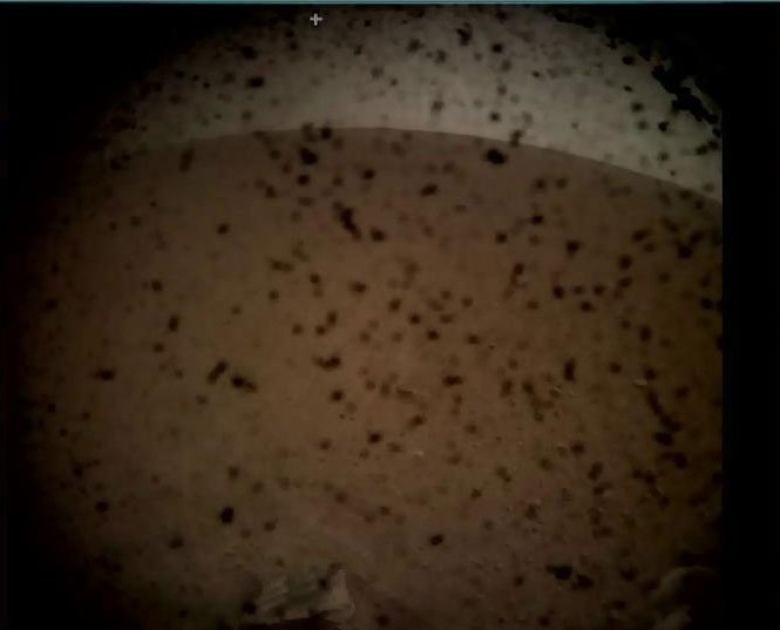
The first photo sent back to Earth after the InSight lander touched down on Mars on Monday: a view of a flat, smooth expanse on the Red Planet called Elysium Planitia.
The plan called for the spacecraft to go from 19,800 km/h to zero in six minutes flat as it pierced the Martian atmosphere and settled on the surface.
“Landing on Mars is one of the hardest single jobs that people have to do in planetary exploration,” said InSight’s lead scientist, Bruce Banerdt. “It’s such a difficult thing, it’s such a dangerous thing that there’s always a fairly uncomfortably large chance that something could go wrong.”
Mars has been the graveyard for a multitude of space missions. Up to now, the success rate at the red planet has been only 40 per cent, counting every attempted flyby, orbital flight and landing by the U.S., Russia and other countries since 1960.

An artist’s concept shows the InSight lander, its sensors, cameras and instruments. After a six-month journey, the spacecraft successfully touched down on Mars on Monday. (NASA/JPL-Caltech)
The U.S., however, has pulled off seven successful Mars landings in the past four decades, not counting InSight, with only one failed touchdown. No other country has managed to set and operate a spacecraft on the dusty red surface.
InSight was shooting for Elysium Planitia, a plain near the Martian equator that the InSight team hopes is as flat as a parking lot in Kansas with few, if any, rocks.
This is no rock-collecting expedition. Instead, the stationary 360-kilogram lander will use its 1.8-metre robotic arm to place a mechanical mole and seismometer on the ground. The self-hammering mole will burrow five metres down to measure the planet’s internal heat, while the seismometer listens for possible quakes.
Thank you, sir — happy to be here! <a href=”https://t.co/4XMS4ohZd6″>https://t.co/4XMS4ohZd6</a>
—@NASAInSight
Nothing like this has been attempted before on Mars, a planet nearly 160 million kilometres from Earth. No lander has dug deeper than several inches, and no seismometer has ever worked on Mars.
By examining the interior of Mars, scientists hope to understand how our solar system’s rocky planets formed 4.5 billion years ago and why they turned out so different — Mars cold and dry, Venus and Mercury burning hot, and Earth hospitable to life.
InSight has no life-detecting capability, however. That will be left to future rovers. NASA’s Mars 2020 mission, for instance, will collect rocks that will eventually be brought back to Earth and analyzed for evidence of ancient life.