Women who use shelters in Alberta are facing increased risk of being murdered by their intimate partners, new statistics indicate.
Almost 65 per cent of women who completed danger assessments in 2017/18 were found to face “severe or extreme levels of danger,” up from 54 per cent in 2011/12, the Alberta Council of Women’s Shelters (ACWS) reported in its latest release of data about shelters and the people they serve.
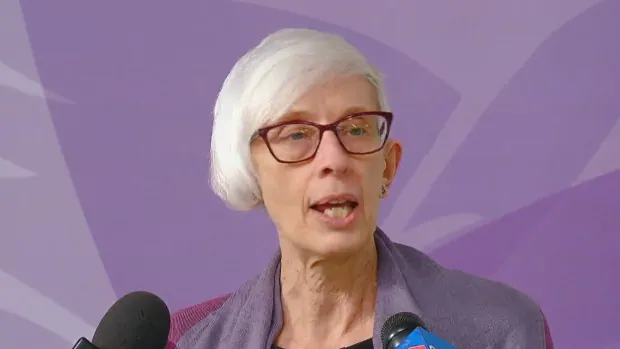
The “specialized and scientifically validated” danger assessment tool measures the risk of a woman being murdered by her intimate partner, Jan Reimer, the council’s executive director, told a news conference Tuesday in Edmonton.
Women who complete the tool are asked to fill in a calendar of past abusive events and answer a series of 20 questions. The tool gives the most weight to answers about strangulation and being threatened with a gun.
“So when you’re seeing that increase, it’s largely because more women are answering yes to those questions which are more heavily weighted because of their potential lethality,” Reimer said.
“If someone has got their hands around your neck and is cutting off your oxygen, well, that’s a pretty good sign of lethality. And guns are often used as a source of intimidation in the home. Sometimes they are just propped up, you know — you don’t have to threaten that often. But guns kill people.”
‘Power and control’
Answering a reporter’s question, Reimer said economic factors don’t play a major role in levels of domestic violence.
“When the economy gets better, domestic violence goes up, and when it gets worse, it goes up,” she said. “So there’s different stressors, but the underlying issue of domestic violence is power and control, and the desire of one individual to dominate another.”
Reimer said the danger assessment tool is valuable for shelter staff but can also help women who answer the questions “identify their own level of risk.”
Data shows that crisis calls to shelters increased by 10 per cent since 2015/16, to 58,117 in 2017/18.
Alberta shelters accommodated 10,390 women, children and seniors in 2017/18.
In the same period, 16,722 women, children and seniors were turned away due to lack of capacity. That statistic means that on the first day the shelter was called, accommodation was not available.