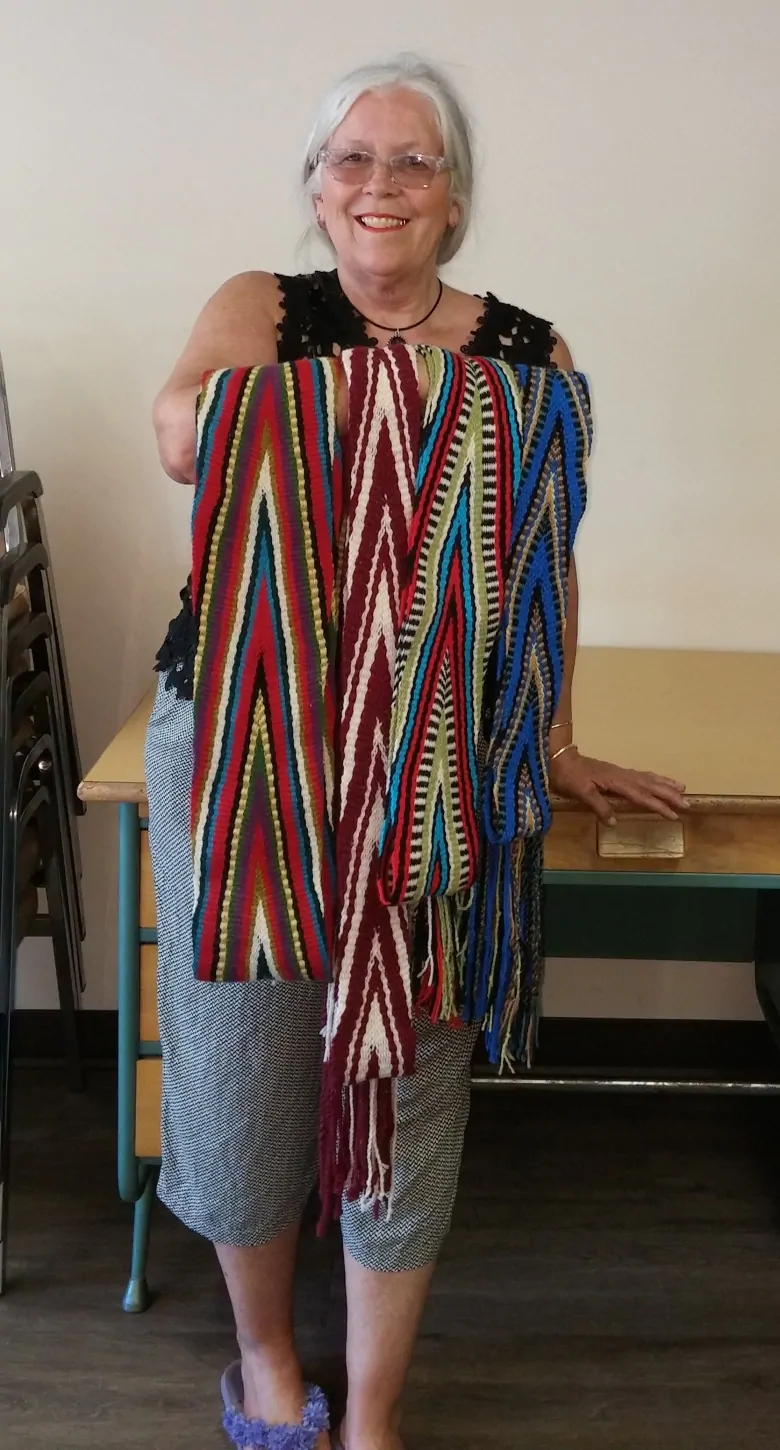
When Patricia Sinclair fell in love with the traditional Métis art of finger-weaving sashes she wanted to learn more, but had trouble finding a teacher.
“Then there was Jessie Clemons,” Sinclair said.
Sinclair wrote to Clemons, a Métis woman from Montana. Clemons eventually travelled to Prince Albert to teach Sinclair the techniques.
Now Sinclair wants to make it easier for others to take up the art.
She’s giving classes on traditional finger-weaving at the Saskatoon Farmer’s Market’s night market on October 25 and at every night market until Christmas.
‘I’ve been encouraged by many Métis men and women’
Sinclair’s journey to teaching began at the Saskatchewan Polytechnic’s Woodland campus, where she attended a weaving program for three years.
In 1995, the Duck Lake Interpretive Centre requested she weave Métis sashes for the East wall of the museum.
“I’m not Métis and I must say I didn’t know the difference between a traditional sash and a sash woven in 1950 or the present,” she said.
So she called Jessie Clemons and learned.
Patricia Sinclair shows off her traditional Métis hand-woven sashes. Her first sash took two years to complete. (Submitted by Patricia Sinclair)
“Along the way, I’ve been encouraged by many Métis men and women,” she said, including Métis family members, who she said are very proud.
It was tough in the beginning. Sinclair’s first sash took her two years to complete.
“I was making mistakes,” she said.
She had to undo her stitching, go back and restart.
“You have to follow what you’re taught and stay between the lines. You can’t go off and do what you want,” she said
“In a way it has tamed my rebellious and lazy nature, and it’s humbled me.”
A colourful history
There are pieces of weaving found in South America that we can’t duplicate today. We have no idea how they did it.– Patricia Sinclair
Part of what drew Sinclair to the sashes is the history. She wants to preserve it.
“There are pieces of weaving found in South America that we can’t duplicate today. We have no idea how they did it.”
In Saskatchewan, Métis sashes like the ones Sinclair produces were popular during the fur trade.
Sinclair said the sashes were used by the Métis for trading. They are colourful because they’re also used for dance.
“It’s part of our history, and it’s a very colourful history,” she said
“Those sashes accentuated who they were.”