Coastal residents fleeing a potentially devastating blow from Hurricane Florence in the southeastern U.S. encountered empty gasoline pumps and depleted store shelves as the monster storm neared the Carolina coast with 225 km/h winds and drenching rain that could last for days.
While some said they planned to stay put despite hurricane watches and warnings that include the homes of more than 5.4 million people on the East Coast, many weren’t taking any chances.
A steady stream of vehicles full of people and belongings flowed inland Tuesday, and North Carolina Gov. Roy Cooper tried to convince everyone to flee.
“The waves and the wind this storm may bring is nothing like you’ve ever seen. Even if you’ve ridden out storms before, this one is different. Don’t bet your life on riding out a monster,” he said.
Government ‘totally prepared,’ Trump says
Forecasters said Florence was expected to blow ashore late Thursday or early Friday, then slow down and dump 30 to 60 centimetres of rain that could cause flooding well inland and wreak environmental havoc by washing over industrial waste sites and hog farms.
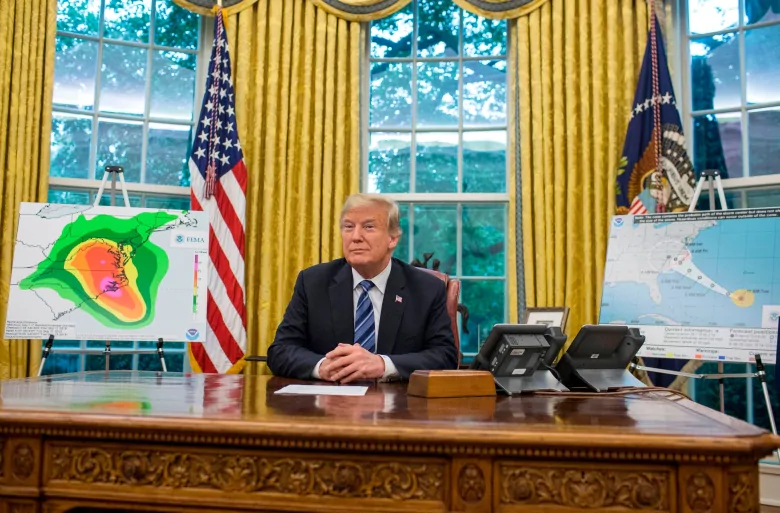
U.S. President Donald Trump declared states of emergency for North and South Carolina and Virginia, opening the way for federal aid. He said the federal government is “absolutely, totally prepared” for Florence.
U.S. President Donald Trump is pictured following a briefing on Hurricane Florence in the Oval Office at the White House on Tuesday. He says the government is ‘totally’ prepared. (Zach Gibson/AFP/Getty Images)
All three states ordered mass evacuations along the coast. But getting out of harm’s way could prove difficult.
Michelle Stober loaded up valuables on Tuesday at her home on Wrightsville Beach to take back to her primary residence in Cary, N.C. Finding fuel for the journey was tough.
“This morning I drove around for an hour looking for gas in Cary. Everyone was sold out,” she said.
‘There’s no water’
Florence is so wide that a life-threatening storm surge was being pushed 485 kilometres ahead of its eye, and so wet that a swath from South Carolina to Ohio and Pennsylvania could get deluged.
People across the region rushed to buy bottled water and other supplies, board up their homes, pull their boats out of the water and get out of town.

Traffic moves west on all lanes of I-26 Tuesday in Columbia, S.C. A lane reversal was implemented earlier in the day, utilizing all lanes for travel west between Charleston and Columbia in anticipation of the arrival of Hurricane Florence. (Sean Rayford/Associated Press)
Long lines formed at service stations, and some started running out of gas as far west as Raleigh, with bright yellow bags, signs or rags placed over the pumps to show they were out of order. Some store shelves were picked clean.
“There’s no water. There’s no juices. There’s no canned goods,” Kristin Harrington said as she shopped at a Walmart in Wilmington.
Winds approaching 250 km/h
People weren’t the only ones fleeing to get out of the path of Hurricane Florence. Eight dogs and 18 cats from a shelter in Norfolk, Va., were sent to two shelters in Washington to make room for pets expected to be displaced by the hurricane.
At 11 p.m. ET, the storm was centred 1,075 kilometres southeast of Cape Fear, N.C., moving at 28 km/h. It was a potentially catastrophic Category 4 storm but was expected to keep drawing energy from the warm water and intensify to near Category 5, which means winds of 253 km/h or higher.
Florence is the most dangerous of three tropical systems in the Atlantic. Tropical storm Isaac was east of the Lesser Antilles and expected to pass south of Puerto Rico, Hispaniola and Cuba, while Hurricane Helene was moving northward away from land. Forecasters also were tracking two other disturbances.
The coastal surge from Florence could leave the eastern tip of North Carolina under more than 2.75 metres of water in spots, projections showed.
‘This one really scares me’
“This one really scares me,” U.S. National Hurricane Center director Ken Graham said.
Federal officials begged residents to put together emergency kits and have a plan on where to go.

Preston Guiher carries a sheet of plywood as he prepares to board up a Wells Fargo bank in preparation for Hurricane Florence in downtown Charleston, S.C., on Tuesday. (Mic Smith/Associated Press)
“This storm is going to knock out power days into weeks. It’s going to destroy infrastructure. It’s going to destroy homes,” said Jeff Byard, an official at the U.S. Federal Emergency Management Agency.
Forecasters said parts of North Carolina could get 50 centimetres of rain, if not more, with as much as 25 centimetres elsewhere in the state and in Virginia, parts of Maryland and Washington, D.C.
150 centimetres of rain possible
One trusted computer model, the European simulation, predicted more than 115 centimetres in parts of North Carolina. A year ago, people would have laughed off such a forecast, but the European model was accurate in predicting 150 centimetres for Hurricane Harvey in the Houston area, so “you start to wonder what these models know that we don’t,” University of Miami hurricane expert Brian McNoldy said.
Rain measured in feet (30 cm) is “looking likely,” he said.

A man installs storm shutters on a home in Kill Devil Hills in the Outer Banks of North Carolina on Tuesday. (Alex Edelman/AFP/Getty Images)
Florence’s projected path includes half a dozen nuclear power plants, pits holding coal-ash and other industrial waste, and numerous hog farms that store animal waste in huge lagoons.
Duke Energy spokesperson Ryan Mosier said operators would begin shutting down nuclear plants at least two hours before hurricane-force winds arrive.
‘This one is different’
North Carolina’s governor issued what he called a first-of-its-kind mandatory evacuation order for North Carolina’s fragile barrier islands from one end of the coast to the other. Typically, local governments in North Carolina make the call on evacuations.
“We’ve seen nor’easters and we’ve seen hurricanes before,” Cooper said, “but this one is different.”

Two surfers plan to take advantage of the large waves caused by the approaching Hurricane Florence on Tuesday in Surf City, N.C. (Mark Wilson/Getty Images)
Despite all that, 65-year-old Liz Browning Fox plans to ride the storm out in the Outer Banks village of Buxton, N.C., despite a mandatory evacuation order. Her 88-year-old mother refused to evacuate and will stay with her.
“Everyone who is staying here is either a real old timer, someone who doesn’t know where would be better, or someone involved in emergency operations one way or another,” said Fox.
Here are the key messages on Hurricane <a href=”https://twitter.com/hashtag/Florence?src=hash&ref_src=twsrc%5Etfw”>#Florence</a> as of 11pm EDT. The latest full advisory is available on <a href=”https://t.co/tW4KeGdBFb”>https://t.co/tW4KeGdBFb</a> and information specific to your area can be found at <a href=”https://t.co/SiZo8ozBbn”>https://t.co/SiZo8ozBbn</a> <a href=”https://t.co/RQgHxhJW7G”>pic.twitter.com/RQgHxhJW7G</a>
—@NHC_Atlantic