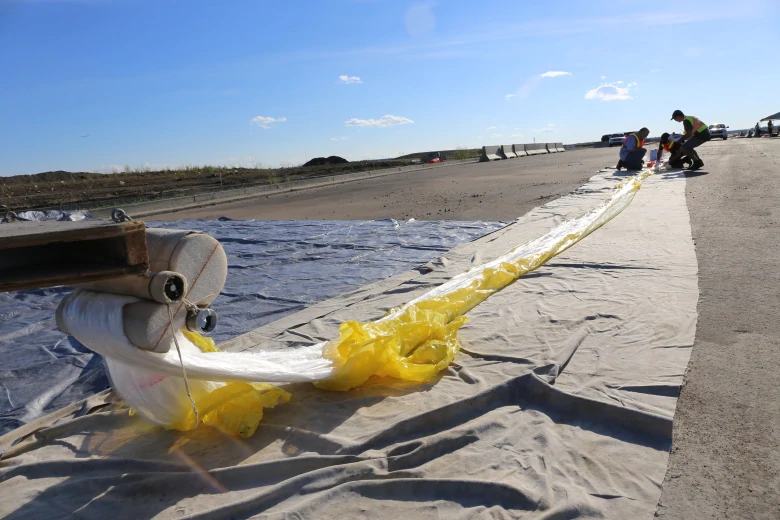
If you gazed up into the Fort McMurray sky this week, you might have seen what looked like a giant floating garbage bag, a jelly fish or even a UFO.
But these sudden appearances in the sky have a more plausible explanation.
This week, Christopher Cully and a team of University of Calgary researchers made a makeshift camp in the undeveloped subdivision of Parsons Creek, and launched at least three high-altitude balloons in an effort to better understand the northern lights.
Cully and his researchers want to learn how X-rays from the aurora borealis interfere with orbiting satellites.
Though the northern lights pose no risk to humans on Earth, up where satellites and spacecraft orbit charged particles can cause havoc with electronic instruments on board spacecraft, such as GPS satellites.
“Now, there’s no threat to any of us on the ground,” said Cully, an associate professor in physics and astronomy. “They hit the upper atmosphere, they make a little bit of X-rays. But the X-rays don’t get anywhere near the ground. In fact, that’s why we have to go up in that high-altitude balloon in order to see these X-rays.”
This high-altitude balloon will ascend 110,000 feet and travel from Fort McMurray all the way to Peace River. (David Thurton/ CBC)

Researchers double-check to make sure all their instruments are working and are fastened properly. (David Thurton/ CBC)

The balloon carried an X-ray imager to record data. (David Thurton/ CBC)
The balloons will ascend to 110,000 feet, about three times the altitude a passenger jet travels, then will float from Fort McMurray to the Peace River region.
Cully has launched similar missions in Saskatoon and Yellowknife that counted and measured the X-rays. But this time, he hopes to capture pictures of the X-rays using an imager device attached to the bottom of the balloon.
“I’m a little nervous and excited with how this is going to go,” Cully said, noting launches and flights can be hampered by weather, the strength of the aurora and equipment issues.
Once the data is collected, the balloon will deflate and the imager inside a Styrofoam box will parachute back to the ground, where a team will retrieve it.
Connect with David Thurton, CBC’s Fort McMurray correspondent, on Facebook, Twitter, LinkedIn or email him at david.thurton@cbc.ca