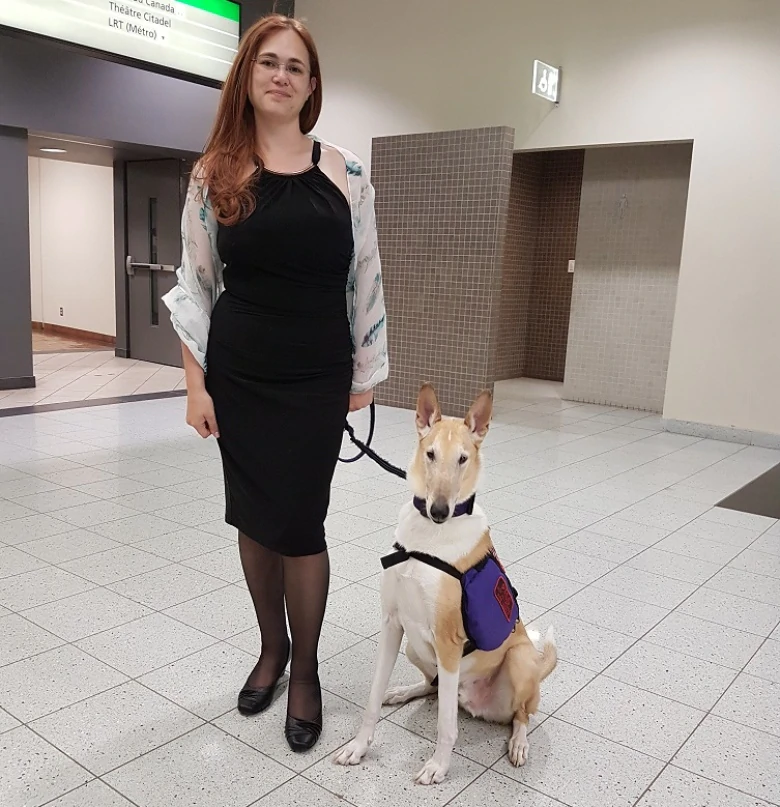
Online efforts to expose fake service dogs are making it harder for people who legitimately use certified service dogs, an Edmonton woman says.
Samantha Hjalmarson says since the Alberta government last year tightened certification regulations, she’s witnessed more scrutiny of owners of certified service dogs.
The judgment comes from within the service-dog community and much of it is online, said Hjalmarson, who uses a certified service dog to help her deal with PTSD.
“[People] will say, ‘Let us know who’s fake and who’s not, we can warn people and post their pictures,’ ” Hjalmarson said.
“When you have anxiety disorders or PTSD, it just creates a lot of stress.”
Hjalmarson was diagnosed with PTSD after enduring sexual abuse as a child.
She spent years unsuccessfully using medication to help her condition, until an organization in Edmonton helped her find her service dog, Lance.
Tighter service dog training rules in Alberta
Despite using Lance as a service dog for several years, the collie was only officially certified last year after amendments were made to the province’s Service Dogs Qualifications Regulations.
The rules are meant to make it clear who is qualified to assess and certify service dogs.
The province says there are now about 210 certified service dogs in Alberta, almost double the number before the new regulations came into effect in August 2017.
According to the province, only eight organizations are qualified to train and assess service dogs in Alberta.
One of the new rules requires the minister of Community and Social Services to maintain a list of the qualified organizations, and clearly outline the training standards.
Dogs that come from a school certified by Assistance Dogs International are also accepted as certified.
Emotional support dogs — known as comfort or therapy dogs — are not considered service dogs, according to the Service Dogs Act.
“Emotional support dogs provide comfort and companionship to the dog owner, but are not trained to do specific tasks that assist a disability,” says a briefing on the ministry website.
The new regulations give owner-trained dogs the chance to become qualified. The old regulations didn’t have a process to qualify owner-trained dogs.
Hjalmarson said she knows how it feels to be scrutinized for having a service dog. People she doesn’t know have questioned whether she needs hers.
Samantha Hjalmarson received government approved certification for her service dog, Lance, last year. (Samantha Hjalmarson)
“One of the first times I had [Lance] I was in West Edmonton Mall and some guy said, ‘Oh, you don’t need a service dog for anxiety, I have anxiety.’ It’s constant … because I don’t have a visible disability,” she said.
To help others in the community who feel scrutinized, Hjalmarson founded the Alberta Service Dog Community, a Facebook group dedicated to helping with advocacy and education for service dog owners.
“We don’t allow discussions about fake service [dogs] … because it causes people to be afraid to ask for help,” she said.
“The language around service dogs is that they have to be quiet, they can’t do this or that. In the industry we understand that they’re not robots … people start judging them,” she said.
Steep fines
In Alberta, a person purporting to be disabled to obtain a service dog can be fined up to $300 if found guilty under the Service Dog Act. The same fine applies to anyone who refuses to return a service dog identification card if they’re ordered to do so.
Any person or business who refuses to admit a service dog in a designated place can also face fines up to $3,000.
A government spokesperson said no fines have been issued under the Service Dogs Act.