Unprecedented efforts are in the works to help a malnourished and possibly sick young killer whale last spotted off the B.C. coast — if officials can find her in time.
J-50 is nearly four years old and part of the critically endangered southern residents, a population of killer whales with only about 75 individuals.
Last week, the U.S. National Oceanic and Atmospheric Administration announced plans to try to treat the whale with medication, either injected by dart or delivered in live salmon.
But no one has seen J-50 or her pod since Friday off Vancouver Island, said NOAA and Fisheries and Oceans Canada in an update Tuesday.
It’s not unusual for wild whales to be out of sight for some time, but J-50’s condition was so poor it’s not clear how long she has left.
“It is very possible that she has succumbed at this point, and we may never see her again,” said Teri Rowles, marine mammal health and stranding program coordinator with NOAA.
“We are hopeful that there is still a chance that we will be able to assist her with medical treatment to give her enough time to get nourishment and treat infections, if indeed that is causing her decline.”
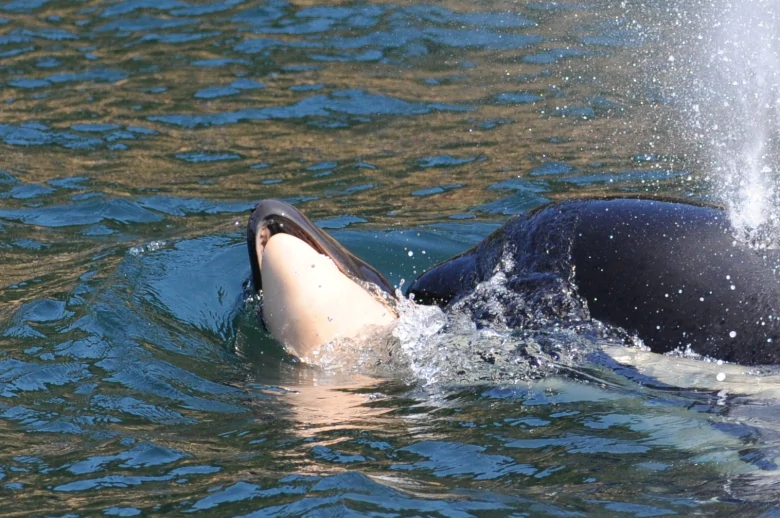
Killer whales belonging to J-pod have attracted worldwide attention since another member, mother J-35, recently carried her dead baby for days in what was described as a display of grief. (Ken Balcomb/Centre for Whale Research)
Canadian fisheries officials still need authorization to help
With that hope — and under the worldwide attention on J-Pod since a mother whale carried her dead newborn calf for days — officials on both sides of the border are preparing to act.
NOAA says it has legal authorization to try something it’s never done before, which is feed the whale live medicated chinook salmon, as a way of delivering oral antibiotics.
The first step, however, would be to assess the whale’s health and try delivering medication in a more conventional way, by approaching J-50 by boat and using either a dart or pole to inject her.
In Canada, where the whales were last seen, the fisheries department does not yet have the legal ability to treat the whale, said marine mammal coordinator Paul Cottrell.
He said the department is working urgently to secure permits.
Southern resident killer whales are endangered under the Species at Risk Act, with multiple threats to their survival including declining chinook salmon, shipping noise, pollution, and other human interaction.
Foggy conditions off the west coast of Vancouver Island have made it difficult to spot any whales, said Cottrell.