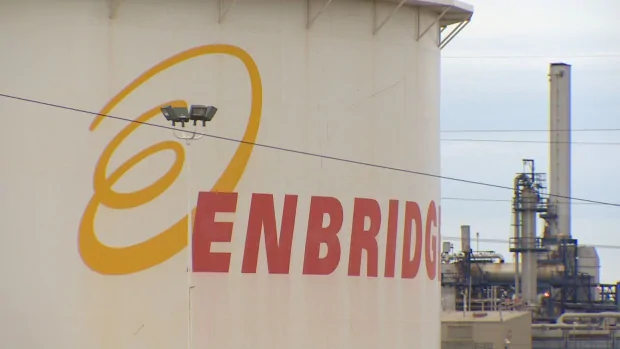
The Transportation Safety Board of Canada (TSB) says a failure to collect accurate field measurements on the locations of buried pipelines contributed to a pipeline rupture east of Edmonton last year.
On Feb. 17, 2017, an Enbridge-owned pipeline was struck and punctured during the construction of the TransCanada Grand Rapids pipeline.
The pipeline transports crude oil from the Fort McMurray area to terminals in Edmonton and Heartland.
Roughly 1,000 cubic metres of petroleum crude oil condensate was released into a nearby excavation pit where construction work was being done in an industrial area in Strathcona County, east of Edmonton.
A Ledcor Pipeline Limited construction crew working for TransCanada Corp caused the damage. The crew was boring a pathway for the new pipeline, when Line 2A was accidentally struck.
‘There were missed opportunities’
An investigation by the Transportation Safety Board, released Monday, determined that excavation workers failed to collect field measurements of the pipeline’s exact location and depth before horizontal directional boring took place.
Measurements taken from an adjacent pipeline were used instead, assumptions were made about the location of pipeline crossings in the area, and an incorrect drilling path was chosen, the TSB concluded.
“If detailed procedures for amending crossing agreements are not established and followed, not all pipelines being crossed may be accurately identified, increasing the risk of damaging an operating pipeline during a ground disturbance,” reads the TSB report, released Monday.
“If critical information about the location of pipelines being crossed is not obtained and shared with all relevant parties, an incorrect drill path may be established, increasing the risk of damage to the pipeline during horizontal directional boring.”
At the surface of the pipeline crossing, an access ramp for heavy vehicles extended over the pipeline.
Because the access ramp was not removed to visually inspect the pipeline, field measurements to confirm the exact position and depth were not performed, the TSB concluded.
Even though a depth confirmation of the underground pipeline was not completed, a daily safety checklist for the construction project incorrectly stated that the inspection had been done.
“In addition, a ground disturbance checklist completed at the start of the shift incorrectly indicated that visual depth confirmation had been performed for all pipelines to be crossed,” reads the report from TSB.
“As a result, there were missed opportunities to further assess the drill path.”
Following the rupture, Enbridge launched an internal review of of communication procedures, including clarifying and harmonizing technical terminology related to pipeline crossings.
GRP Ltd. enhanced pipeline crossing procedures and checklists, and issued further guidance to employees. Ledcor enhanced its procedures related to line crossings.
Most of the released product was recovered. No one was injured in the rupture.
The TSB investigates incidents or mishaps involving pipelines that cross provincial or international borders and may make recommendations.
The National Energy Board continues to monitor remedial actions at the spill site.