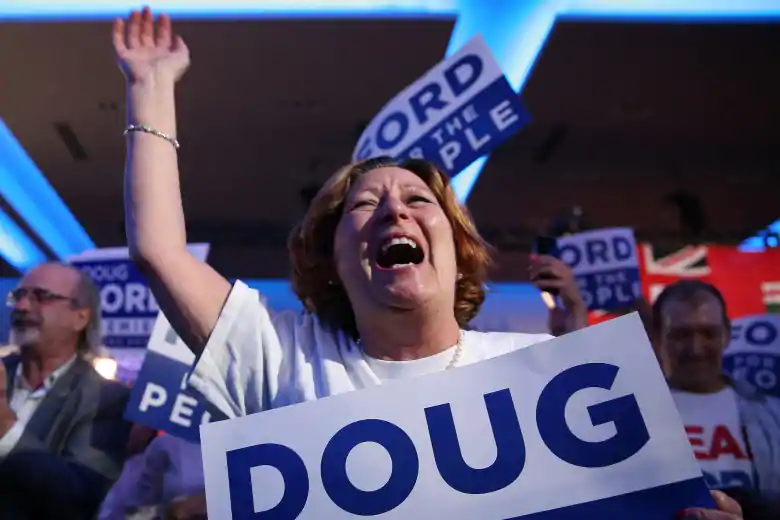
Led by Doug Ford, Ontario’s Progressive Conservatives have secured a majority government, ending nearly 15 years of Liberal power in the province.
The NDP will form the Official Opposition, while the embattled Liberals were handed a historic rebuke from voters, losing the vast majority of their seats at Queen’s Park with their lowest-ever share of the popular vote.
Shortly after results were announced, Kathleen Wynne revealed she will resign as Liberal leader, as the Grits failed to pick up the eight seats necessary to maintain official party status.
Buoyed by Ford — a one-term Toronto city councillor and businessman — the PCs ran a populist campaign long on commitments but short on fiscal details, promising a tax cut for the middle class and corporations and a drastic reduction in the price of hydro and gasoline.
The PCs were the only party that did not release a fully costed platform prior to election day.
Riding a wave of entrenched anti-Liberal sentiment, the Tories managed to win 76 seats, up from the 27 they held when the campaign kicked off in May.
“My friends, this victory belongs to you. This victory belongs to the people. And tonight, the people of Ontario have spoken,” Ford said in a speech to supporters at an event in Toronto.
“I promised to deliver a strong, stable majority government and together we did that. Together we made history. We have taken back Ontario, we have delivered a government that is for the people,” he continued.
“A new day has dawned in Ontario — a day of opportunity, a day of prosperity and a day of growth.”
With more than 99 per cent of polls reporting, voter turnout was about 57.7 per cent, a notable increase from 2014, when turnout was 51 per cent.
Ford handily won his seat in Etobicoke North, the symbolic heartland of “Ford Nation,” the term given to an unwavering core of supporters who also backed his late brother, former Toronto mayor Rob Ford.
In his victory speech, Ford became emotional as he thanked his brother.
Ford was easily elected in his riding of Etobicoke North. (Carlo Allegri/Reuters)
“I know my brother Rob is looking down from heaven. I’m just getting chills talking about him right now. I know Rob is celebrating with us tonight. We owe so much to Rob’s legacy,” Ford said.
The PCs made significant gains in the 905 and throughout the Greater Toronto Area, regions that are critical to the political landscape in Ontario because the number of seats that are concentrated within them.
“Tonight we have a sent a clear message to the world: Ontario is open for business,” Ford said in his address.
As was expected, NDP Leader Andrea Horwath held onto her seat in Hamilton Centre, where she has served as an MPP since 2004. Heading into election day, polls suggested that the NDP had a slim chance of eking out a win. While such an improbable scenario never materialized, the New Democrats managed to take 39 seats, up from the 18 they held when the campaign began.
“I could not be more proud that we offered a positive vision: change for the better. New Democrats rejected the politics of fear and cynicism, and we put hope and vision for a better future at the heart of our campaign,” Horwath told supporters in Hamilton.
“Together, we won more seats than we have held in a generation. And I am deeply humbled that Ontarians have asked us to serve as the new Official Opposition.”
The election results represent a marked turnaround for the NDP, a party that has consistently found itself in third place since Bob Rae’s government was defeated in 1995.
Meanwhile, in a historic first for Ontario, Green party Leader Mike Schreiner has won a seat in Guelph.

Ontario NDP Leader Andrea Horwath was re-elected in Hamilton Centre, which she has represented since 2004. (Peter Power/Canadian Press)
Wynne resigns as Liberal leader
Wynne, Ontario’s first female and openly LGBT premier, was re-elected in Don Valley West, though the race was much tighter than it has been in previous years.
However her incumbent Liberals, who had enjoyed a majority since 2014, suffered a stunning collapse. The party only managed to secure seven seats, which means they have lost official party status in the Legislature. They were also nearly wiped off the political map in Toronto, an area that was key to their majority.
Similarly, in terms of the popular vote, it was the Liberal’s worst showing in the party’s history, with 19.6 per cent. It has never before finished with less than 20 per cent of the popular vote.
Several prominent Liberal cabinet ministers also lost their seats, including Charles Sousa, Yasir Naqvi, Steven Del Duca and Glenn Thibeault.
Last weekend, Wynne took the extraordinary step of admitting publicly that she would not be Ontario’s premier after the vote. Acknowledging the impending defeat, she encouraged voters to elect Liberals to ensure the next government is kept “in check.”
“This is not a concession speech — I conceded days ago. This is my chance to say thank you for allowing me to be premier, allowing me to connect with so many of you the last five years” Wynne told supporters on Thursday night.
She announced that she will resign as leader of the Liberal party, effective immediately.
“There is another generation, and I am passing the torch to that generation,” Wynne said as she fought back tears.
“I know that tonight is not the result we were looking for and no one feels that more sharply than I do, but this is not a moment where any of us should linger. We can’t stay here,” she continued.
“I hope that you can feel very proud of what we have done together in the past and absolutely determined to take on the task that lies ahead.”

Kathleen Wynne announced she will resign as leader of the Ontario Liberal Party following a crushing rebuke at the polls. (Tijana Martin/Canadian Press)
The PCs’ election victory comes after a memorable and at-times vicious campaign that proved difficult for Ford and some of his candidates. What began as a commanding lead in public opinion polls steadily narrowed over the month-long battle.
Ford, unaccustomed to the scrutiny that a provincial campaign draws, faced down multiple controversies and alleged scandals. One his former candidates was forced to resign over his alleged links to a data breach at the company who operates Ontario’s Highway 407.
And three days before the election, the widow of his late brother, former Toronto mayor Rob Ford, sued the Tory leader. The suit claims Ford withheld money from her and her two children, and that Ford’s Toronto- and Chicago-based businesses are bleeding money.
Under Ford, the PCs recaptured the province they have not led since 2003, overcoming the failings of the past three elections that saw them unable to defeat the Liberals. In some cases those campaigns were sunk before they barely got off the ground with promises to fund religious schools or cut 100,000 public sector jobs.
Ford took the reins of the party less than three months ago, winning the leadership race on the third ballot after former leader Patrick Brown abruptly resigned.