The Alberta government has created an anti-racism advisory council and will provide grant money to groups that are fighting racism, according to a report released Wednesday.
The advisory council, to be made up of members of varying ethnic and cultural backgrounds and Indigenous peoples, will “shape how we tackle discrimination,” the government says the report titled Taking Action Against Racism.
Advisory council members will help guide the province’s work when it comes to fighting marginalization, according to a new framework, which was largely based on conversations with community representatives in 2017.
A community anti-racism grants program will fund better training and support services for groups fighting racism, with a dedicated stream of funding for groups led by Indigenous peoples, the report says. The grant program will be the first time the NDP government has funded community activities that specifically target racism.
Premier Rachel Notley called for action against racism in Alberta following the Quebec City mosque shooting in early 2017. Education Minister David Eggen consulted with Albertans who experience racism first-hand.
The report shows that hate crimes happen about once every three days in Alberta. In 2016 there were 88 police-reported hate crimes against racial minorities and 25 based on religion.
“We do value equality, we are an open and welcoming people, and there is racism here,” reads the report, which was prepared by the Ministry of Education.
“That’s the bad news.”
The report details several actions to fight racism. They are expected to get underway immediately. Grant applications, for example, are set to open this summer.
The province will share updates on the progress of various anti-racism measures online.
10 future actions
The report lists 10 other actions the province will consider in the future, following input from the community. The actions include:
- Creating a provincial hate crimes unit
- Funding the Alberta hate crimes committee
- Updating the school curriculum to include more material on fighting racism
- Expanding the number of languages students can learn core subjects in, from eight to 10
- Expanding career mentorship programs to smaller cities
- Starting a foreign qualification fund that measures skills and work experience, not just credentials
- Making it easier for people to have access to anti-racism resources by creating a multilingual phone line
- Reflecting Alberta as a government by removing biases in hiring and training employees about Indigenous awareness
- Making sure Albertans know their rights
- Celebrating the province’s diversity
Accountability
Ahmed Abdulkadir, executive director of Edmonton’s Ogaden Somali Community of Alberta Residents, was one of many people consulted for the framework.
The community advocate said he’d like to see a timeline for the actions proposed for the future, but is confident the government will be held accountable due to its bottom-up approach.
“That’s where the beauty of the advisory council comes in,” he said. “The community will have a voice to advocate which direction the province should go and what needs to be implemented.”
Abdulkadir said overall, he’s happy with the new framework, but would like to see a few other problems addressed, like the speed at which human rights complaints are addressed.
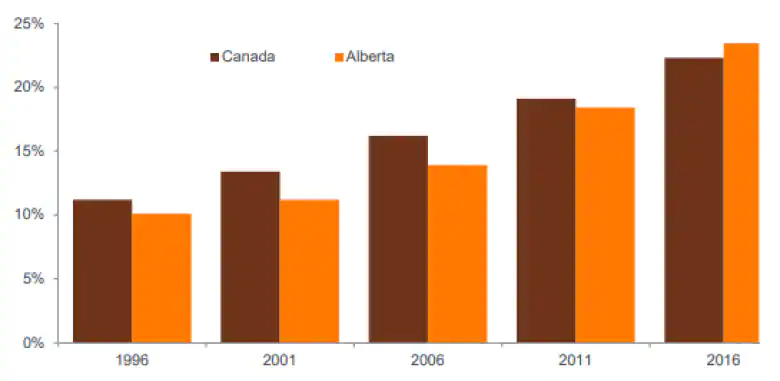
This graph based on census figures shows how racial diversity in Alberta and Canada has grown over the past 20 years. (Government of Alberta)
The framework comes at a time when diversity is growing in Alberta.
One in four Albertans are from different racial backgrounds, according to the report, which cites census figures. That’s compared to about one in 10 in 1996.