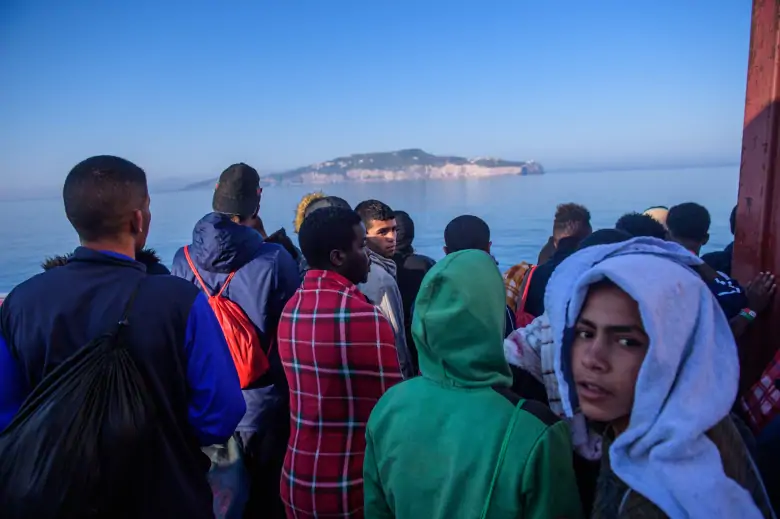
Italy and Malta dug in for a second day Monday and refused to let a rescue ship with 629 people aboard dock in their ports, leaving the migrants at sea as a diplomatic standoff escalated under Italy’s new anti-immigrant government.
“Enough!” said Italian Interior Minister Matteo Salvini. “Saving lives is a duty, but transforming Italy into an enormous refugee camp isn’t.”
He tweeted: #Chiudiamoiporti. “We’re closing the ports.”
Maltese Premier Joseph Muscat also refused to take in the Aquarius ship of the humanitarian group SOS Mediterranee. He accused Italy, which co-ordinated the rescue, of violating international norms governing sea rescues.
Italy’s position, Muscat said, risks “creating a dangerous situation for all those involved.”
Migrants on April 23 watch the Sicilian coast from the Aquarius vessel as they arrive in Trapani, Italy. Italy has called on Libya and the European Union in help stemming the flow of arrivals that have arisen after a Balkan route was closed off. (Christophe Petit Tesson/EPA-EFE)
As the rhetoric intensified, the Aquarius remained on standby in the Mediterranean Sea with its 629 passengers, including 123 unaccompanied minors and seven pregnant women. The ship said it had been ordered by Italy’s coast guard co-ordination centre late Sunday to remain 55 kilometres off Italy and 45 kilometres from Malta.
The migrants had been rescued during a series of operations Saturday by Italian maritime ships, cargo vessels and the Aquarius itself. All passengers were offloaded to the Aquarius to be taken to land.
The United Nations called on the countries to resolve the issue, describing it as an “urgent humanitarian imperative.”
“People are in distress, are running out of provisions and need help quickly,” said Vincent Cochetel, special envoy for the central Mediterranean for the UN Refugee Agency. “Broader issues such as who has responsibility and how these responsibilities can best be shared between states should be looked at later.”
Migrants unaware of political incident brewing
Doctors Without Borders, which has staff aboard the Aquarius, tweeted a video of some of the women aboard the ship praying Monday morning and said they were unaware of the diplomatic drama being waged on land over their fate.
“Thank you Lord,” the women sang. The group said it “urgently requests a swift resolution and a designated port of safety.”
The standoff marked the first inevitable clash over migrant rescues with League leader Salvini, now running Italy’s Interior Ministry. Salvini campaigned on an anti-immigrant platform that also included a vow to expel hundreds of thousands of migrants already in Italy, even though experts doubt such mass deportations are feasible or financially viable.
Malta, for its part, has consistently refused to take in migrants, citing its small size and limited capacities.
The island nation of some 415,000 people has progressively reduced the number of migrants it has taken in over the past decade, from a high of 2,775 in 2008 to just 23 last year, according to UN statistics.
Las mujeres, al despertarse, rezan. ‘All I have to say: thank you, God’ ( Sólo puedo dar gracias a Dios). <a href=”https://twitter.com/hashtag/aquarius?src=hash&ref_src=twsrc%5Etfw”>#aquarius</a> <a href=”https://twitter.com/MSF_Sea?ref_src=twsrc%5Etfw”>@MSF_Sea</a> <a href=”https://twitter.com/rne?ref_src=twsrc%5Etfw”>@rne</a> <a href=”https://t.co/gtlIx5mx4n”>pic.twitter.com/gtlIx5mx4n</a>
—@SAlonsoEsparza
Salvini pointed to Malta’s unwillingness in accusing Europe as a whole of leaving Italy on its own to deal with the refugee crisis. He noted that other European countries are very much involved in current rescue operations in the Mediterranean — including a German aid group currently off Libya — but no country is stepping up to actually take in the migrants.
“Italy has stopped bowing our heads and obeying,” Salvini said in a Facebook post. “This time we say no.”
The standoff is actually the third in recent weeks, after the outgoing government of Premier Paolo Gentiloni refused to let humanitarian aid groups dock in Italian ports until the ships’ flag nations had formally requested permission. Those incidents delayed the migrants’ arrival, but they ultimately made it to Italy.