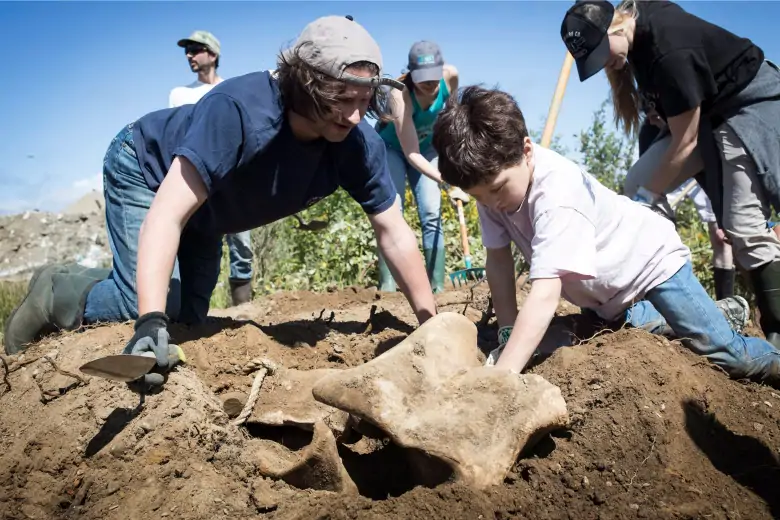
It was a stinky process, but scientists and about a dozen volunteers have dug up a grey whale buried at a Vancouver Island landfill and are calling the project a success.
Gavin Hanke, the curator of vertebrate zoology at the Royal B.C. Museum, says he’s never exhumed a whale from a dump, but its bones are in excellent shape for scientists to study.
Nomi DeRoos, 7, helps Josh McInnes of Marine Life Studies uncover the bones of the grey whale on May 31. (Melissa Renwick/The Canadian Press)
Hanke says the body of the young female grey whale washed up on Wickaninnish Beach near Tofino, B.C., more than three years ago, and museum officials were forced to decide whether to haul it out to sea or bury it at the nearby dump and save the skeleton.
He says the decision to save the whale’s bones means scientists can examine a recently deceased marine mammal for signs of its health in times of climate change.

Biologists with Fisheries and Oceans Canada and Parks Canada dissected the body of the young grey whale, which washed up on Wickaninnish Beach near Tofino in 2015. (CHEK)
It’s not the first time a beached whale has been buried and later exhumed so the skeleton can be preserved and put on display.
In 2010, UBC put a blue whale skeleton on display at the Beaty Biodiversity Museum after it was dug up on Prince Edward Island.

Carl Sieber from Parks Canada digs up the whale’s vertebrae at the landfill site. (Melissa Renwick/The Canadian Press)