In a downtown Toronto bar last Sunday evening, the big screen televisions were tuned to a NASCAR race. That was until 6 p.m., when a patron bellied up to the bar.
“I want to watch the debate,” he told the bartender.
It wasn’t crowded that hot evening, so the bartender didn’t get much pushback when he switched the channel to the final televised debate between leaders in the Ontario election.
What began as what looked like a sure-thing, straightforward contest favouring the new leader of the Ontario Progressive Conservatives, Doug Ford, has evolved into a two-way road race, with plenty of curves and sharp turns.
The Ontario election is a race between the PCs and NDP, with many Alberta eyes focused squarely on the finish line, knowing their own election is likely less than a year away.
The Ontario contest is reminiscent, in a way, of the 2015 Alberta election, when the determined NDP climbed steadily in the polls while almost nobody noticed until the final week of the campaign.
Alberta, of course, was in an entirely different mindset and political position than Ontario is now.
Alberta had more than 40 years of one-party rule by the PCs. A divided centre-right vote between the Progressive Conservatives and the Wildrose party, plus a collapsing Liberal party, set things up for the NDP.
However, the parallels between the Ontario and Alberta NDP platforms and performances are interesting.
Similar platforms and performance
Here are just a few examples:
Both platforms focus on making life better for working families, affordable child care and a higher minimum wage.
And just like the Alberta campaign, the Ontario NDP is asking corporations to pay “just a little bit more,” something Alberta NDP Leader Rachel Notley liked to say during the campaign.
And there is that error in calculations.
Some two weeks before voters went to the polls in May 2015, Notley unveiled her party’s detailed fiscal plan. It would balance the books in 2017, the same timeline as the PCs and Wildrose parties envisioned.
But a few days later, just before a news conference about affordable housing, Notley corrected the record. A multi-million dollar error was discovered, pushing back the NDP’s plan for balance back by a year.
At the time, Notley got out in front of the mistake, arguing it was a testament to good leadership that a mistake was discovered and quickly acknowledged.
Fast-forward to the Ontario election.
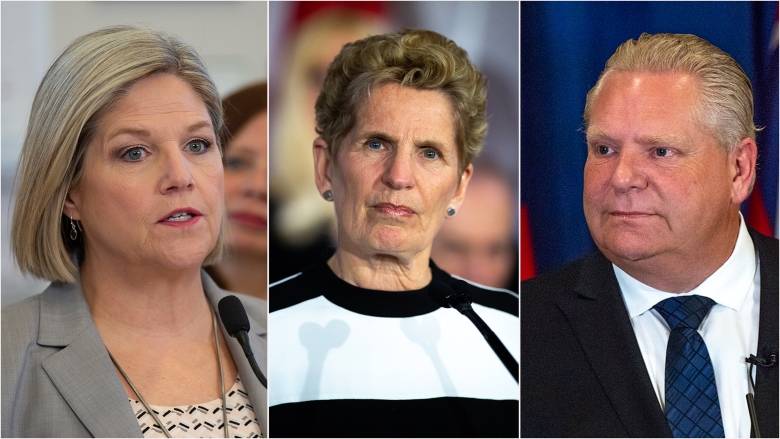
Photo of Andrea Horwath (left) NDP Leader, Kathleen Wynne (centere), Liberal Party Leader and Doug Ford (right), PC Party Leader. (David Donnelly photos/CBC)
NDP Leader Andrea Horwath, about two weeks before voters go to the polls in Ontario, faced her own calculation problem.
In the Ontario NDP case, it was a $1.4-billion annual costing mistake in the election platform affecting deficit projections for several years.
‘A grain of salt’
“Most people take those numbers with a grain of salt,” said John Soroski, a professor of political science at MacEwan University in Edmonton.
Soroski said he sees the parallels between the Alberta and Ontario campaigns. But there are vastly different circumstances as well.
“The 2015 election in Alberta was a monumental election that will go down in history,” he said. That’s not the case in Ontario.

John Soroski says there are similarities and differences between Rachel Notley’s 2015 victory in Alberta and the upcoming provincial election in Ontario. (Jason Franson/The Canadian Press)
Soroski said there is public fatigue in Ontario, where voters are ready for a change similar to previous federal elections. But he doesn’t see a historic shift on the way, comparable to what happened in Alberta in 2015.
From afar, Soroski said it might look as though the movie cast for the next Alberta election is playing out in Ontario.
“You could draw [Doug] Ford into [Jason] Kenney’s place, and [Andrea] Horwath into [Rachel] Notley’s place” for the next Alberta election, said Soroski, who added that’s where the comparison ends.
Still, political watchers are captivated by what’s playing out in Canada’s most populous province. Both the Alberta NDP and Kenney’s UCP have people working on the Ontario election.
Spring vacation
Some Alberta government and UCP employees have taken their vacations to answer phones, map out strategy, or tag along the campaign trail in Ontario.
Roari Richardson, provincial secretary of the Alberta NDP, said he is excited by what he sees happening in Ontario, adding he’d love to be there too, if it wasn’t so close to Alberta’s next election.
In an interview on CBC Edmonton’s The Ledge podcast, CBC Ontario provincial affairs reporter Mike Crawley said support for Horwath has surged for a very basic reason.
“I think it’s simple,” said Crawley, “she’s neither Kathleen Wynne, nor Doug Ford.”
Interviewed while on a campaign bus, Crawley said crowds for Horwath have been steady but nothing remarkable. However, there’s no doubt the Ontario NDP have become the go-to party for disaffected Liberal voters.
The fascination with the Ontario election, more pipeline politics, and an unscripted moment when the federal finance minister spoke to the Calgary Chamber of Commerce, are all on this week’s edition of The Ledge.