U.S. President Donald Trump has launched “precision strikes” against targets associated with Syrian President Bashar al-Assad’s chemical weapons capabilities.
The strikes come in response to an alleged chemical attack last weekend in Douma, a community not far from Damascus. Activists say it killed more than 40 people and injured many more — but Syria and its ally Russia have issued various denials.
Speaking at a hastily arranged news conference Friday night, Trump said the U.S. is prepared to sustain the response “until the Syrian regime stops its use of prohibited chemical agents.”
The U.K. and France are also on board, he said.
But Trump also said that the U.S. “does not seek an indefinite presence in Syria, under no circumstances.”
-
Analysis
‘Get ready Russia’: Trump’s strategy of applying pressure carries risk of escalation, expert says
He described the horrors of chemical attacks, and said “we never want to see that ghastly spectre return.”
“So today, the nations of Britain, France and the United States of America have marshaled their righteous power against barbarism and brutality,” he said.
British Prime Minister Theresa May said in a statement that the strikes should come as a surprise to no one.
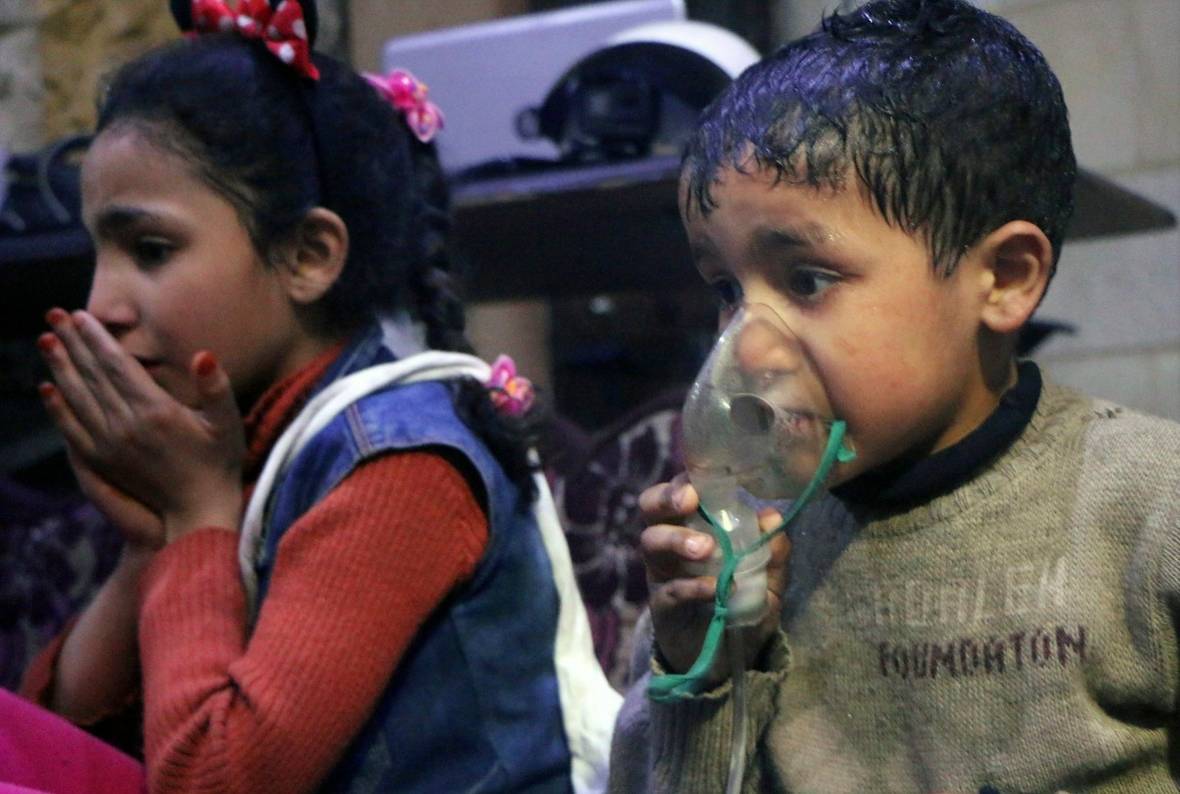
This image released early Sunday by the Syrian Civil Defence White Helmets, shows a child following an alleged poison gas attack in the rebel-held town of Douma. (Syrian Civil Defense White Helmets via AP)
“We have sought to use every possible diplomatic channel to achieve this,” May said. “But our efforts have been repeatedly thwarted.”
French President Emmanuel Macron also confirmed that he had ordered military intervention.
Moscow said on Friday its experts had inspected the site and found no sign of chemical weapons. Several top Russian officials, including Foreign Minister Sergey Lavrov, went so far as to call claims by the West and others a “fabrication.”
At his news conference on Friday, Trump also had harsh words for Russia and Iran, who he hold responsible for financing and equipping the Assad regime, saying “What kind of a nation wants to be associated with the mass murder of innocent men, women and children? The nations of the world can be judged by the friends they keep.”
The Associated Press reported loud explosions lighting up skies over the Syrian capital of Damascus, along with heavy smoke, as Trump announced the airstrikes.
Syrian state TV said the army’s air defences were confronting an attack by the United States, France and Britain.
Threats of ‘big price’
The strikes come after days of heated rhetoric. Earlier this week, Trump said on Twitter that there would be a “big price to pay” for Douma and, in the days since, tensions have risen amid heated debate about what happened and how, or if, to respond.
Speaking at the United Nations on Thursday, Russian Ambassador Vassily Nebenzia said the top priority had to be to avert a wider war — but he didn’t rule out the possibility of a U.S.-Russia conflict
Attack kills dozens in Douma, but government denies involvement 1:11
Nebenzia’s remarks came after Russia’s ambassador to Lebanon, Alexander Zasypkin, offered his own threat, saying, “If there is a strike by the Americans then… the missiles will be downed and even the sources from which the missiles were fired.”
The World Health Organization (WHO) said this week that reports show that during Saturday’s shelling, an estimated 500 people “presented to health facilities exhibiting signs and symptoms consistent with exposure to toxic chemicals.”
The patients presented with “severe irritation of mucous membranes, respiratory failure and disruption to central nervous systems of those exposed,” the WHO said. The Organization for the Prohibition of Chemical Weapons has dispatched a fact-finding team to Syria, and they were expected to start their probe on Saturday.
U.S. Defence Secretary Jim Mattis has previously said that, although Washington has no hard proof, he believes the Assad government was responsible for Saturday’s attack.
But Macron says France has proof the regime attacked with chlorine gas. Macron, who along with the U.K. had been in consultation with the U.S. about the possibility of a strike, said France would not tolerate “regimes that think everything is permitted.”
Earlier this week, Prime Minister Justin Trudeau told Radio-Canada that Canada isn’t considering a presence in Syria.
On Friday night, Foreign Affairs Minister Chrystia Freeland spoke to reporters from Lima, Peru, where she is attending a summit.
“When it comes to this use of chemical weapons, it is clear to Canada that chemical weapons were used and that they were used by the Assad regime,” Freeland said.
This isn’t the first time Trump has retaliated against Syria over chemical weapons.
Around this time last year, Trump launched dozens of Tomahawk missiles at a government-controlled airbase in central Syria in response to a deadly chemical attack that killed dozens of people.
Welcome to The National, the flagship nightly newscast of CBC News 0:00