If you happen to be lucky and have clear skies tonight, step outside and look west for a beautiful pairing.
After the sun sets, you’ll be able to catch an extremely slender crescent moon together with the bright jewel of the night sky, Venus.
You’ll have to have a keen eye to spot the moon. Just two days old, it will only be a sliver, 4.6 per cent illuminated. The two will be roughly five degrees apart, or about the width of your three centre fingers held at arm’s length.
Venus, on the other hand, will shine like a beacon in the sky. Often, the second — and brightest — planet in our sky is mistaken for an airplane. And yes, even a UFO.
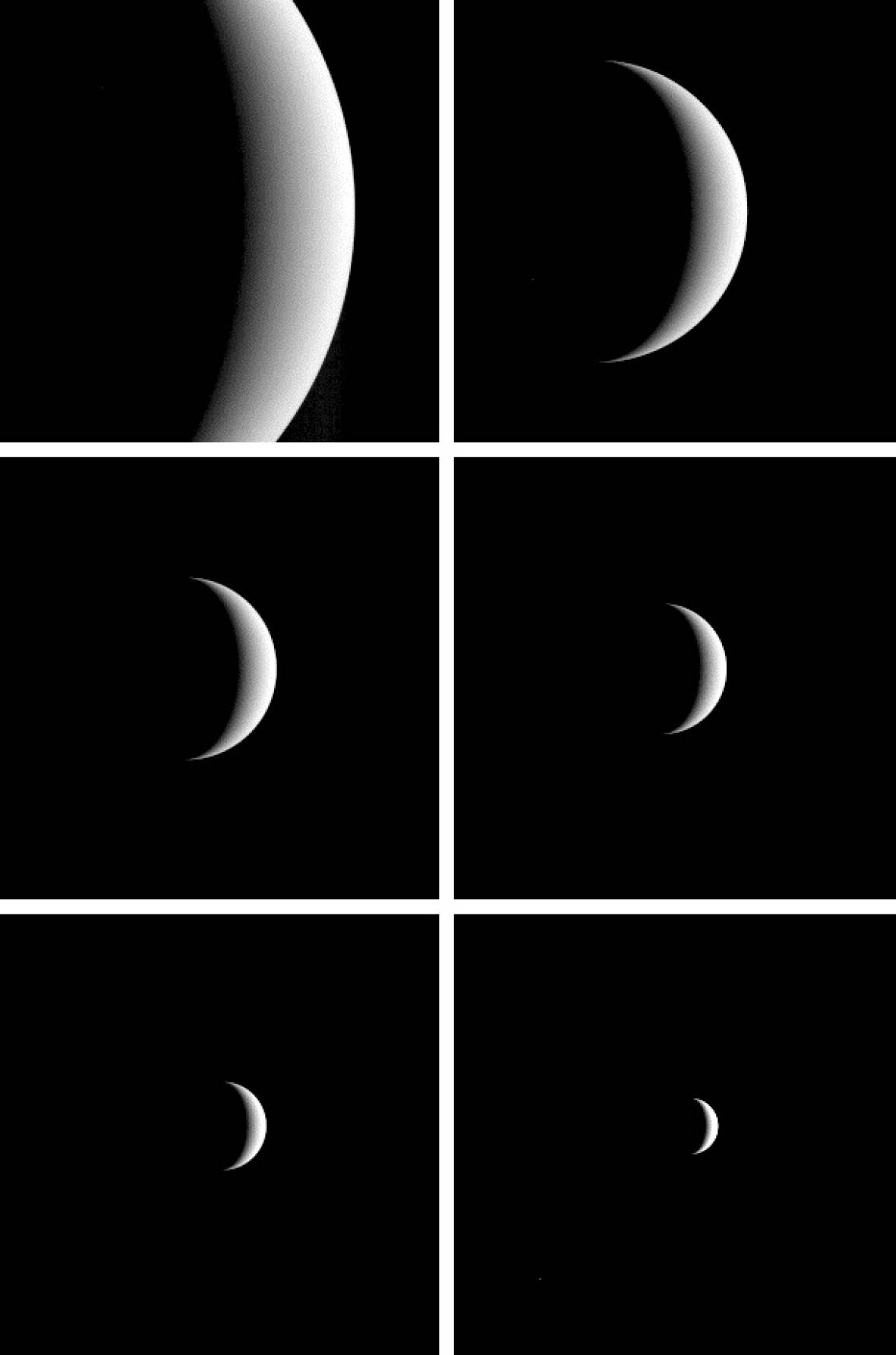
The moon isn’t the only thing that goes through phases. Seen from Earth, Venus also experiences phases much like the moon’s.
Venus, looking similar to our crescent moon, is seen here, imaged by the Mercury Surface, Space Environment, Greochemistry, and Ranging (MESSENGER) spacecraft in 2007. (NASA/Johns Hopkins University Applied Physics Laboratory/Carnegie Institution of Washington)
If you miss the pair Tuesday night, you’ll get another chance in exactly a month on May 17, when they join again. This time, the moon will be roughly eight per cent illuminated.
Over the next few months, if you’re willing to stay up into the wee hours of the morning, you can spot three more planets.
This week, Jupiter rises in the southeast just before 10:30 p.m. in your time zone, followed by Saturn before 2:30 a.m., and Mars just before 2:45 a.m. As the months carry on, they will rise earlier in the night.
By mid-July, you’ll have a planetary smorgasbord with the trio stretching from the southeast to the southwest at a much more decent hour around 11:30 p.m.