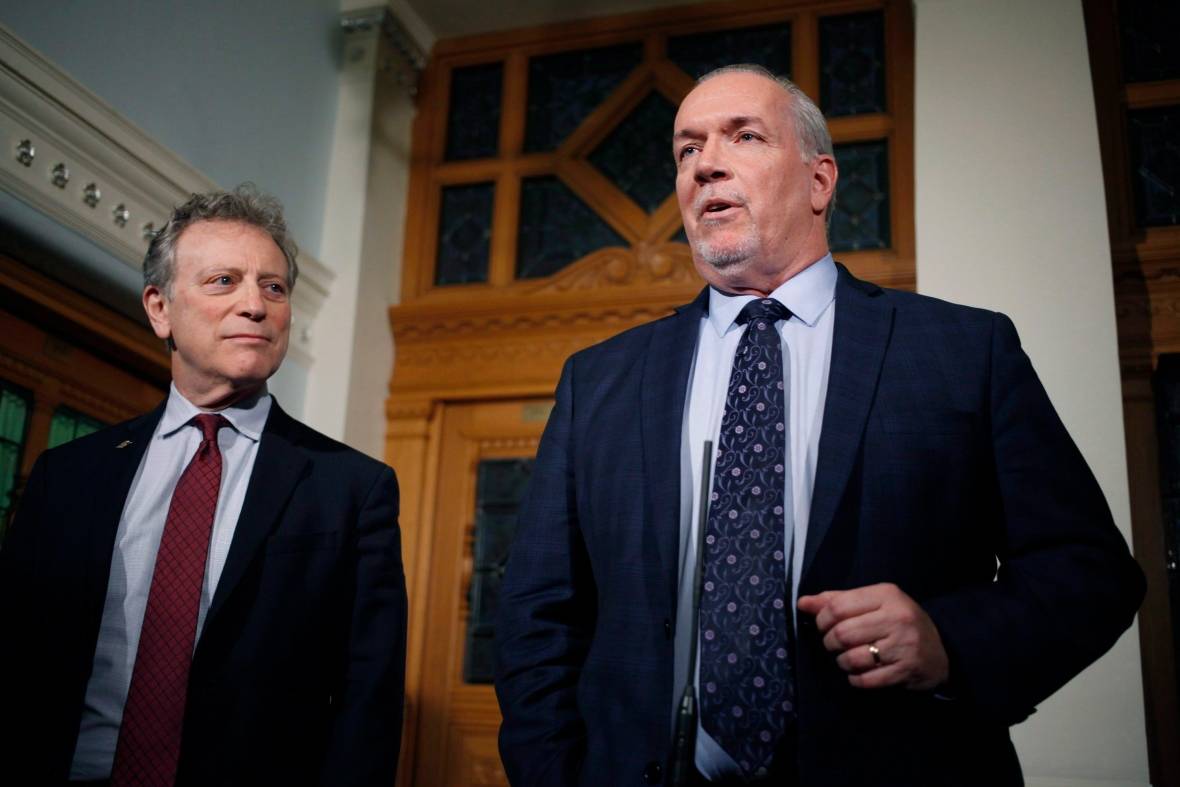
B.C. is asking the province’s top court to determine if it has the right to bring in a new set of regulations for companies looking to ferry large amounts of heavy oil through the province.
As part of its reference case filed last week, the provincial government is putting draft legislation before the court that would amend the Environmental Protection Act.
The province is essentially asking the court if it has the jurisdiction to bring that draft into reality.
“In other words, can we do it?” Attorney General David Eby said Thursday.
Under the draft, companies hoping to bring more diluted bitumen through B.C. would need a permit from the province. They could also be required to show a spill response plan in advance.
An independent director would issue the permits, making their decision based on the best scientific research available. The director would also consult with Indigenous groups and the broader public.
The legislation would only apply to the movement of heavy oils, which the province considers to be the highest risk in the event of a spill.
The proposed legislation would not affect current shipments of diluted bitumen through B.C. It would only apply to companies seeking to expand shipments.
B.C. Premier John Horgan and Minister of Environment George Heyman are scheduled to join Attorney General David Eby for an announcement about the reference case on the Trans Mountain pipeline on Thursday morning. (Chad Hipolito/Canadian Press)
There is no estimated timeline on how long it will take the court to hear the reference case.
Premier John Horgan has said B.C.’s coast and jobs could be at risk if the Trans Mountain expansion goes through, tripling the capacity of an existing pipeline between Edmonton and Burnaby, B.C.
Alberta is in favour of the project, as is the federal government. The provinces have been sparring over the pipeline for weeks, in a battle that has sparked trade wars and a national summit with Trudeau.
Ahead of the announcement, federal Environment Minister Catherine McKenna reiterated Ottawa’s intention to get the pipeline built.
In statement addressed to Heyman, she outlined environmental measures she says the federal government has already taken to mitigate the damage in the event of a spill, including increased capacity to tow ships and five new emergency response stations.
McKenna also floated the idea of a joint Ottawa-B.C. panel of scientists to enhance existing research on oil spills to address the province’s concerns.
The panel would make use of the science available on oil spills, including current examples of how to respond, should a number of different petroleum products spill.

A kayaker paddles past the Kinder Morgan yard in Burrard Inlet in North Vancouver, B.C. on May 3, 2012. (Jonathan Hayward/Canadian Press)
McKenna also says B.C.’s environment consultations ignored federal programs and policies, which she says explain why Ottawa believes the pipeline is sound.
Pipeline builder Kinder Morgan curtailed spending on the $7.4-billion project earlier this month, blaming opposition and delays in B.C.
The company set May 31 as the deadline for the B.C., Alberta and federal governments to find a solution to the impasse. Prime Minister Justin Trudeau has repeatedly vowed that the project will go ahead.