B.C. is asking its highest court to decide if the government has the right to bring in stricter rules for companies looking to ferry more heavy oil — like diluted bitumen — through the province.
That would include crude flowing by way of an expanded pipeline, including Kinder Morgan’s expanded project.
As part of its reference case filed Thursday morning, the province put draft legislation before the court that would amend the Environmental Protection Act with the new regulations.
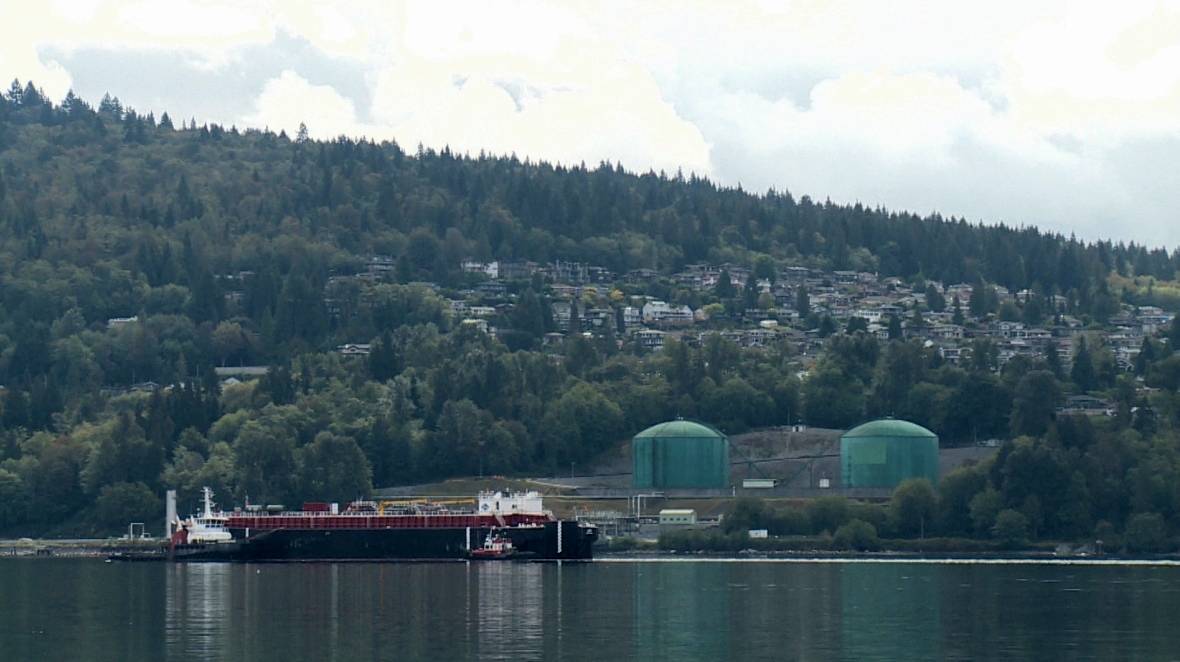
Kinder Morgan’s Burnaby facility would pump nearly 900,000 barrels of diluted bitumen into tankers each day if the proposed expansion is completed. (Rafferty Baker/CBC)
The province is essentially asking the B.C. Court of Appeal if it has the jurisdiction to bring that draft into reality.
“In other words, can we do it?” Attorney General David Eby said Thursday.
It’s the latest move in B.C.’s resistance to the Trans Mountain pipeline expansion project.

B.C. Attorney General David Eby, Environment Minister George Heyman and Premier John Horgan all spoke at the announcement from the provincial legislature. (Michael McArthur/CBC)
Under the draft, companies hoping to bring more diluted bitumen through B.C. would need a permit from the province.
Companies could also be required to show a spill-response plan in advance.
An independent director would grant the permits, making the decision based on the best scientific research available. The director would also consult with Indigenous groups and the broader public before making a choice.
The new legislation would only apply to the movement of heavy oils, which the province considers to be the highest risk in the event of a spill.

A kayaker near Cates Park in North Vancouver gazes at the new fencing surrounding Kinder Morgan’s marine terminal late last year. (Jon Hernandez/CBC)
The proposed legislation would not affect current shipments of diluted bitumen through B.C. It would only apply to companies seeking to expand shipments.
There is no estimate on how long it will take the court to hear the reference case. In Canadian law, governments submit reference questions to the courts to ask for advisory opinion on major legal issues.
Premier John Horgan has long said B.C.’s coast and jobs could be at risk if the pipeline expansion goes through, tripling the capacity of an existing pipeline between Edmonton and Burnaby, B.C.
“We know that British Columbians have a deep, personal connection with our coast, with our fish, with our wildlife,” Horgan said Thursday.
“It’s our responsibility to defend the interests of British Columbians.”
Pipeline politics
Alberta is in favour of the project, as is the federal government. The provinces have been sparring over the pipeline for weeks, in a battle that has sparked trade wars and a national summit with Prime Minister Justin Trudeau.
Alberta Premier Rachel Notley said B.C.’s explanation of its reference case “makes no sense.”
“If bitumen were so hazardous, why would we only be looking at the incremental bitumen that’s in the new pipeline?” she said Thursday.
“This isn’t about environment, this is about the new pipeline.”
Notley, a lawyer, said she doesn’t believe B.C. has jurisdiction “to do what they are proposing to do.”

Alberta Premier Rachel Notley said B.C.’s arguments for new regulations ‘make no sense.’ (Jason Franson/Canadian Press)
Ahead of the announcement, federal Environment Minister Catherine McKenna reiterated Ottawa’s intention to get the pipeline built.
In a statement addressed to B.C. Environment Minister George Heyman, she outlined environmental measures she says the federal government has already taken to mitigate the damage in the event of a spill, including increased capacity to tow ships and five new emergency response stations.
McKenna also floated the idea of a joint Ottawa-B.C. panel of scientists to enhance existing research on oil spills to address the province’s concerns.
The panel would make use of the science available on oil spills, including current examples of how to respond, should a number of different petroleum products spill.

Environment Minister Catherine McKenna reaffirmed the federal government’s commitment to the Trans Mountain pipeline expansion project ahead of B.C.’s announcement, saying it’s in the national interest to do so. (Colin Perkel/Canadian Press)
McKenna also says B.C.’s environment consultations ignored federal programs and policies, which she says explain why Ottawa believes the pipeline is sound.
Kinder Morgan curtailed spending on the $7.4-billion project earlier this month, blaming opposition and delays in B.C.
The company set May 31 as the deadline for the B.C., Alberta and federal governments to find a solution to the impasse. Trudeau has repeatedly vowed that the project will go ahead.