The Kremlin has denounced British Foreign Secretary Boris Johnson’s statement comparing the World Cup in Russia to the Olympics hosted by Nazi Germany as “utterly disgusting.”
The tough response marks an escalating war of words between Moscow and London over the poisoning in Salisbury in southwestern England of former Russian spy Sergei Skripal and his daughter with a military-grade nerve agent. Britain blamed the March 4 attack, which also sent a British police officer to hospital, on Russia.
Johnson agreed Wednesday with a Labour lawmaker who likened the soccer World Cup hosted by Russia this summer to Adolf Hitler’s use of the 1936 Olympics as propaganda for his regime.
Russian President Vladimir Putin’s spokesman Dmitry Peskov described it Thursday as “the utterly disgusting statement which is unworthy of a foreign minister of any country.” He called Johnson’s words “insulting and unacceptable.”
Russia has fiercely denied the poisoning accusations.
Casts suspicion on nearby British lab
Alexander Yakovenko, Russian ambassador to the United Kingdom, held a news conference in London soon after Peskov’s comments. While he did wish a speedy recovery for the Salisbury victims, he spent much of his time of claiming Britain has a history of violating international law and can’t be trusted in the Skripal investigation.
He criticized Theresa May’s government for issuing a series of ultimatums and not following international protocols in requesting information.
Yakovenko said the British “built an official position on pure assumptions” and have failed to provide Russian counterparts with adequate proof to back up their assertions.
The ambassador pointed to the existence of the British military lab at nearby Porton Down as a potential source of the so-called Novichok nerve agent.
“Is it a coincidence that this chemical weapons facility is only eight miles [12 kilometres] away from the site of the [Skripal] incident?,” he said. “How did doctors what antidotes to administer to the victims?”
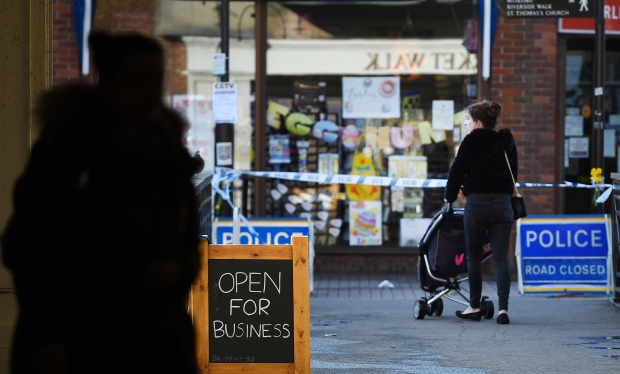
Pedestrians walk past the scene on March 19 where ex-Russian spy Sergei Skripal sat on a bench with his daughter Yulia, covered with a forensic tent in Salisbury. (Andy Rain/EPA-EFE)
Yakovenko took criticism for an earlier tweet that seemed to make the light of the seriousness of the situation, in which he referenced an Agatha Christie detective.
He defended the tweet on Thursday.
“We don’t have any information,” Yakovenko told reporters. “The investigation is classified. We don’t know the motivation of the British government, and that’s why it says: this case is so complicated, we need, let’s say, some wisdom of a person like Poirot to investigate.”
Yakovenko also expressed dismay at the Johnson statement, pointing out that Russia lost millions of citizens during the Second World War fighting the Hitler regime.
Meanwhile, Britain is seeking help from other European countries to take action against Russian spy networks that could be preparing similar attacks.
May is expected Thursday to urge “co-ordinated action” among European Union governments at a summit in Brussels, where she will also try to persuade the bloc’s leaders to condemn Russia squarely over the attack in Salisbury.
British diplomats stressed May was not seeking a formal or immediate EU strategy because the bloc has little joint competence on intelligence, meaning any such work would be done directly with other governments.
European Council President Donald Tusk, who will chair the summit and has sided with Britain, said: “It is clear we should improve our preparedness for future attacks.”
He wants the bloc to discuss how to better protect itself from chemical and biological attacks, including in cooperation with NATO, as well as to how to beef up counter-intelligence capabilities to combat hybrid threats.