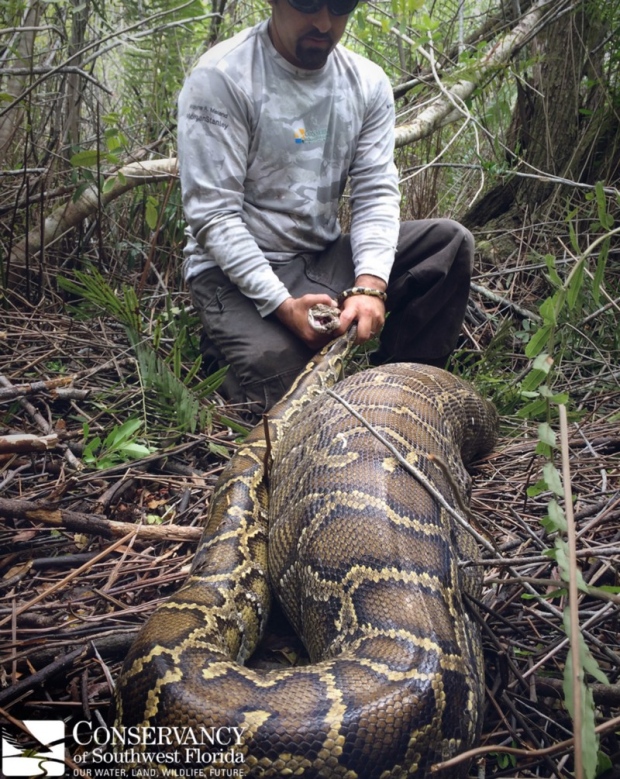
Researchers studying invasive Burmese pythons in Florida came upon something they’d never seen before: a 3.4-metre-long (11-foot-long) python had consumed an entire deer that weighed more than the snake itself.
The wildlife biologists tracking the slithery creatures stumbled upon a bloated female snake in Collier Seminole State Park, and when they moved the creature it began regurgitating a white-tailed deer fawn, the researchers reported in an article on the blogging site Medium.
WARNING: Graphic images in the link below.
The Conservancy of Southwest Florida documented a Burmese python eating a white-tailed deer that weighed more than the python itself.
Read More: https://t.co/EcdspkYUHI#invasivespeciesawarenessweek #SciComm #BurmesePython pic.twitter.com/UOe6hX0FQz
The fawn had a mass of 15.88 kilograms (35 pounds); the snake 14.29 kilograms (31.5 pounds).
“We were sitting there just trying to process that an animal this size could get its head around what turned out to be a deer,” biologist Ian Bartoszek told the Naples Daily News. “It’s surreal to see that in the field.”
Researchers stumbled upon a bloated female snake in Collier Seminole State Park, and when they moved the creature it began regurgitating a white-tailed deer fawn. (Conservancy of Southwest Florida)
Bartoszek said it was the largest python-to-prey weight difference he had measured.
Burmese pythons, which can grow nearly six metres (20-feet long), were brought to South Florida as pets in the late 1970s. They were released into the wild, and have become a problematic invasive species.
White-tailed deer are an important food source for Florida’s endangered panthers, so the researchers are concerned the pervasive snakes could also impact the health of the big cats.

The Burmese python (14.29 kg) was cut open by researchers to show the white tailed deer fawn (15.88 kg) that it had swallowed. (Conservancy of Southwest Florida)
If the snake had been left in the wild, it would have digested the entire deer, Bartoszek said.
He said the predator-to-prey size ratio stunned his team.
“It showed my team and myself what we were actually dealing with out there, what this python is capable of,” he told the newspaper.
The findings will be published in the March 2018 issue of Herpetological Review.