Prime Minister Justin Trudeau has touched down in Pikangikum, a remote community in northwestern Ontario some 500 kilometres from Thunder Bay, in an effort to see what more the federal government can to do help the impoverished community.
The reserve is one of the country’s largest — populated by 3,100 Ojibway-speaking peoples, many of whom are under the age of 30.
This afternoon, Trudeau, who is in the midst of a cross-country town hall tour, will also host a Q&A with school children at Eenchokay Birchstick School.
CBCNews.ca will carry his remarks live starting at 2:20 p.m. ET.
Trudeau’s visit is historic in that no sitting prime minister has ever visited a community in Nishnawbe Aski Nation territory — a group of 49 First Nations in the northern reaches of the province with a total population of 49,000.
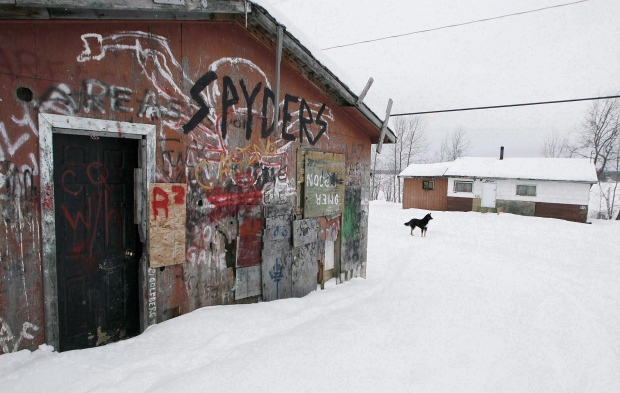
An abandoned house is shown on the Pikangikum First Nation. Last summer, the federal government announced funding to connect the Pikangikum First Nation in northwestern Ontario to the province’s power grid. (John Woods/Canadian Press)
Earlier in the day Trudeau, accompanied by NAN Grand Chief Alvin Fiddler, met with the community’s band council and pledged more federal support to improve the quality of life in a community that is inaccessible by car in the winter.
To that end, the federal Indigenous-Crown Relations Minister, Carolyn Bennett, recently committed some $60 million to finally connect the community to Ontario’s power grid. To this point, the community has relied on diesel generators for electricity, an expensive, unreliable and environmentally unfriendly source of power.
“We see a lot of challenging things in the news from time to time about difficulties faced by people in this community. But I think one of the things I’ve been excited about … is that there is a lot of work being done and a lot of good stories as well that we are working to build,” Trudeau said at his meeting with the band council.
Dean Owen, the chief of Pikangikum First Nation, said housing is the biggest problem facing his community. The backlog of people waiting for homes has doubled since he became chief 13 years ago as the population of band members has nearly doubled from 1,800 in 2005 to 3,100 currently.
Owen says nine and 10 people often share one of the reserve’s existing homes and are forced to sleep in shifts.
He will press the prime minister to flow more funds to build homes, something the government has promised to address in a much-anticipated Indigenous housing strategy. (A national housing strategy was unveiled last fall.)
Some 75 per cent of the community are under the age of 25.