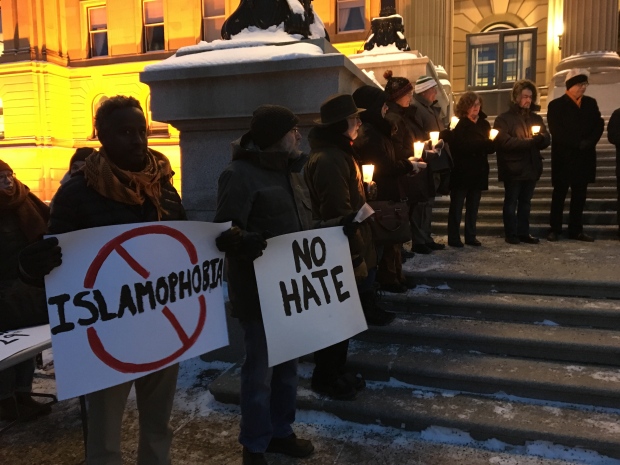
A candlelight vigil at the Alberta Legislature on Monday night commemorated the victims of a horrific act of Islamophobia that took place in a Quebec mosque one year ago.
About 130 people attended the event, bundled up against dropping temperatures and a wind chill that made it feel like -20 degrees.
“I won’t call them Muslim. I won’t call them Canadians. I’ll call them human first,” Imam Sadique Pathan said about the six men who were killed on Jan. 29, 2017, when a gunman entered the Islamic Cultural Centre of Quebec City and shot at the crowd gathered for evening prayers.
Vigil organizers talked about the importance of solidarity in the face of anti-Muslim sentiment. (Kaylen Small/CBC)
“Their only wish,” said Pathan, from Edmonton’s Al Rashid Mosque, “was to go into a place of prayer, a place of peace. And all they sought was that moment, that sacred moment, the thing that’s enshrined in the Charter of Rights and Freedoms, which is that we have the right to practice whatever faith we have, without duress.”
He wants people to consider what the victims were thinking when they left their homes that day.
“Just like you and me, they left a family, and they probably said to the wife, ‘I’ll be back,'” he said. “They probably gave their children, perhaps, a last hug. Perhaps they had the dream of having a home, having a future. They’re no different than you and I.”

Vigil attendees hold signs to show their support for victims on anniversary of Quebec mosque shooting. (Trevor Wilson/CBC)
The men killed in the Quebec attack are Azzeddine Soufiane, Mamadou Tanou Barry, Khaled Belkacemi, Aboubaker Thabti, Ibrahima Barry and Abdelkrim Hassane.
“Six widows, 17 [fatherless children], 19 others injured,” Pathan said. “This is what uncharted hate and free hate speech leads to.”
Pathan said that the killer embodied the definition of the word Islamophobia — the irrational fear of a particular group.
In his speech to the vigil, Pathan reminded them that words matter.

About 130 brave the cold to honour the victims of the Quebec mosque shooting, one year on. (Trevor Wilson/CBC)
“This 27-year-old that perpetrated this act — his religion wasn’t on trial. His culture’s not on trial. His race is not on trial. That’s not the Canadian way,” he said.
“We judge people by their actions. That is the Canadian way. We don’t put an entire race, a religion and background on trial for the action of one individual.”
Concrete actions
Neha Ahmed attended Edmonton’s vigil, saying that it’s important to commemorate the day. She knew it would cold and uncomfortable but she felt it was important to show that Edmonton cares. Similar vigils were held across Canada.
“It’s a really tragic event and something that we need to keep in our minds,” Ahmed said. “I think that the more we remember the fact that racism and hatred isn’t foreign to Canada, the more we can work to combat it.”

Imam Sadique Pathan from the Al Rashid Mosque in Edmonton makes an impassioned speech on the Legislature’s steps at the vigil Monday night. (Trevor Wilson/CBC)
She added that people need to pay attention to what’s happening, in Canada and around the world, and take steps to stand against it.
“I don’t think that just watching and feeling terrible is enough,” Ahmed said.
Organizers stress the importance of solidarity in the face of anti-Muslim sentiment across the province. Premier Rachel Notley released a statement Monday, acknowledging that extreme hatred still lives among us and saying that diversity is our strength.
“We did not, and we will not, give in to hatred and lies and intolerance. Instead we choose love. We choose what is true and right and just.”

Neha Ahmed attended Edmonton’s vigil marking one year since the Quebec mosque shooting, saying that it’s crucial to commemorate the day and take concrete actions to stop Islamophobia. (Trevor Wilson/CBC)
The vigil follows a protest on the same steps of the Legislature earlier Monday afternoon, when about 40 people gathered to protest M-103, a federal motion that condemns Islamophobia.
“I say, to all of them, come and join us in the mosque,” Pathan said. “See what Muslims are. We will embrace you, I promise you. And we’ll feed you.
“We say to them, come and meet with us. We want to extend our hands and our arms to them.”