Edmonton’s space and science experts believe the fallout from a fireball seen in northern Alberta Wednesday might be in the Wood Buffalo area.
The meteor was seen in the sky at about 5:22 p.m., with many people taking to social media to ask others if they saw the same thing.
Frank Florian, the director of planetarium and space sciences at the Telus World of Science, said initial sightings were from Edmontonians who said it was northeast of the city.
[embedded content]
But the next day, he had tons of emails and phone calls from people living in northern Alberta, primarily in Lac La Biche and Fort McMurray.
“[They] saw a much brighter object, even hearing audible sounds like explosions,” Florian said Thursday. That explosive sound they heard would be from how fast the rock travelled through the air.
“As this rock passed through the Earth’s atmosphere, basically the air can’t move out of the way fast enough for these rocks so it hits sort of a brick and then the rock explodes.”
Taking that information from those sightings, Florian and other researchers from the University of Alberta think the debris of the meteor could be found in the Wood Buffalo region.
“We try to triangulate a bit to narrow down the trajectory, the path through the sky, and then figure out where it may have landed,” said Prof. Chris Herd at the University of Alberta.
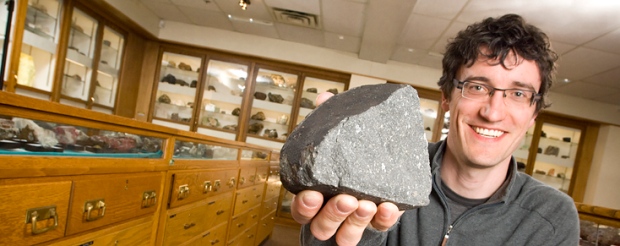
Prof. Chris Herd holds a meteorite, part of the collection at the University of Alberta. (University of Alberta)
‘Fireball season’
Meteorites tend to be heavier than expected and are often dark on the outside and lighter on the inside, Florian said. They’re also often magnetic and can be as big as a fist.
Florian said they’re not that rare. “Things from space fall on the Earth on a daily basis,” he said, but added many aren’t noticed because they aren’t in heavily populated areas.
The end of February to the end of April is deemed “fireball season.” Florian said. That’s when the Earth is likely passing a region in its orbit where there are larger bits of material that could make their way into Earth’s atmosphere.
The University of Alberta recently installed an all-sky camera, hoping to track down more of the meteors falling from the sky. But the camera didn’t capture Wednesday’s meteor. “Unfortunately, it missed it by a few minutes. I’m not exactly sure the reasons why,” Herd said.
2018-0117-53630:27
The hope is in future for the university to have a network of these cameras that will pick up this kind of event on more than one camera, allowing staff to calculate the trajectory, Herd said.
Since it wasn’t captured with the all-sky camera, researchers are relying on people who were in the right place and right time to see it to share their accounts.
If anyone finds debris from the meteor, the university asks they contact them.