Researchers from the University of Calgary have found remnants of a meteor that flashed across the sky in early September.
Estimated at a metre wide and weighing up to five tonnes, the asteroid fragment entered Earth’s atmosphere Sept. 4 with a flash of light visible across Alberta, British Columbia and parts of the northwestern United States.
It was estimated to have landed somewhere in the East Kootenay region of B.C.
Days later, U of C professor Alan Hildebrand issued a call to the public for video of the meteor to better pinpoint where it landed.
That allowed researchers to narrow the search to a 20-kilometre stretch of area running east of Crawford Bay, B.C., to the Kootenay Lake shore north of the Village of Riondel.
Led by Hildebrand, the team began searching. On Oct. 29, the first fragment was found on private land in northeastern Crawford Bay by Fabio Ciceri, a visiting master of science student from the University of Milan.
“At first, I couldn’t believe it. Ever since I was a child, I got up with my father to see the night sky, and it was like a dream to hold a space rock in my hand,” he said in a news release.
The team will continue searching, but the approaching winter will make finding meteorites more challenging.
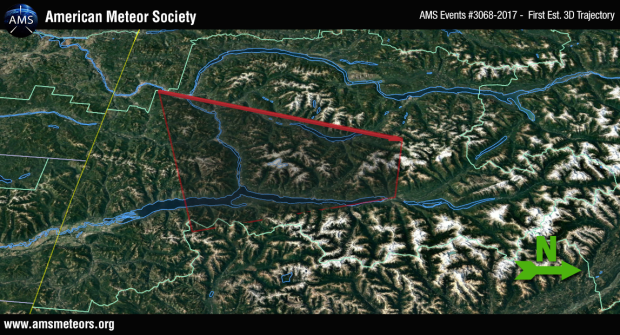
The American Meteor Society has mapped an estimated trajectory of the fireball. The region, in B.C.’s East Kootenay, is sparsely populated.
“We need to recover more and larger meteorites to learn what we can from this fall,” said Hildebrand.
“For example, with enough pieces we can tell how big the rock was when it entered the atmosphere.”
Thousands of meteorites, ranging from the size of a peppercorn up to rocks weighing five to 10 kilograms, will have fallen, but Hildebrand says most will be in the forest that blankets the eastern shore of Kootenay Lake.
He expects people will be finding meteorites in the forest across the strewnfield for several years.