New buyers can expect home ownership to become even less affordable next year, while current owners will be largely insulated from higher rates.
That’s one of the main takeaways of a new outlook from Scotiabank, which forecasts mortgage carrying costs to increase by about eight per cent next year.
That’s almost three times more than what the bank expects household incomes to rise by: 2.5 per cent.
More expensive mortgages coupled with less income to pay for them is a bad combination for new buyers, which is why the bank sees affordability getting further out of reach next year.
The same can’t be said, however, for those who’ve already bought, since most of them are largely insulated from rising interest rates.
About a third of all Canadian households fall in the latter camp, and their standard, five-year fixed-rate mortgage should offer them some protection now that the Bank of Canada seems to have entered into a rate-raising cycle.
“As a result, rising borrowing costs feed through only gradually to mortgage holders,” the bank said. In fact, the majority of borrowers who are set to renew their mortgage in the next little while will likely do so at a rate comparable to, or even lower than, the one they originally signed up for.
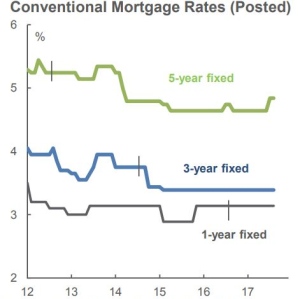
A majority of fixed-rate mortgages coming due in the near term will roll over at interest rates comparable to, or lower, than those they originally got, Scotiabank says. (Scotiabank)
There could be more bad news on the horizon for new buyers, too.
“Further rule changes, including more stringent stress tests for uninsured mortgages, are expected to be unveiled later this year and would exert additional drag on new buyers,” the bank added.
Add it all up, and the bank forecasts that Canada’s housing market seems to have “peaked” and is expected to cool down from its recent breathtaking pace.
“We anticipate some moderation in home sales over the forecast horizon, as rising borrowing costs and tougher mortgage-qualification criteria lead to some further erosion in affordability,” the bank said.
RBC says rate hikes will hurt
Scotiabank isn’t the only big bank to have that view. Rival Royal Bank recently forecast in its own report that affordability has got worse for eight quarters in a row, and across the country is now at its lowest level since 1990.
After two hikes this summer, the bank is expecting four more rate hikes by the end of next year, which would put Canada’s central bank rate at two per cent — a level it hasn’t been at since before the financial crisis of 2009.
That would have a “significant impact” on mortgage holders, as the bank calculates that a one percentage point increase in the central bank’s rate would drive up mortgage rates more than three times that amount.
“All markets would be affected, but the effect would be most substantial in high-priced markets — almost seven percentage points in the case of Vancouver,” the bank said.
“The days of ultra low interest rates in Canada are over,” Royal Bank said. “These increases are just the beginning of a hiking campaign.”
But the picture doesn’t quite look so bleak everywhere across the country.
“It must be said, however, that extremely poor affordability in parts of Ontario and British Columbia skew Canada’s overall picture. Outside of these two provinces, housing affordability trends generally have been more stable,” Royal Bank said.