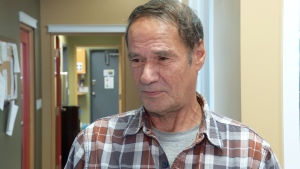
Harvey Sykes remembers when he was a child and his father would toss freshwater clams fished from Fort McMurray’s two rivers into a pot of fish chowder.
Today, he can hardly find any when he goes out on the water.
“Back in those days, there was an abundance of clams,” said Sykes. “It seems now they are disappearing at an alarming rate.”
Sykes, a McMurray Métis board member and elder, tells stories about walking along the Clearwater or the Athabasca rivers and kicking clam shells scattered on the shore. They were everywhere then. Finding one these days is like finding buried treasure.
McMurray Métis board member and elder Harvey Sykes says he has lobbied government and scientists for a decade to study why clams are disappearing. (David Thurton/ CBC)
The McMurray Métis and Alberta Environment and Parks partnered 10 months ago to start the first community-led study of freshwater clams. On Friday, the two groups will hold an information session to update members on their progress.
Sykes said he has been warning government and wildlife researchers for almost a decade that the region’s clams are disappearing.
Where did the clams go?
Clams can be found throughout Alberta.
Alberta Environment and Parks scientist Debra Hopkins said a species commonly called “fat muckets” are found in Fort McMurray.
Project participants were out on the water in August and September searching for clams and taking samples back to the lab.

Volunteers and members from the McMurray Métis collecting clams. (McMurray Métis/ Submitted)
“It was hard to find clams,” said Hopkins, who could barely fill a bucket. “We spent four full days out on the rivers.”
The study is using traditional knowledge to map areas where clams were once found in abundance. They take samples back to a lab to analyse animals’ overall health. It will also assess the water and sediment quality.
There’s no date for the study’s completion, nor are there any early results to give Sykes comfort.
“My only assumption is that it has got to be something in the waters is why they are disappearing,” Sykes said.
Follow David Thurton, CBC’s Fort McMurray correspondent, on Facebook, Twitter or contact him via email.