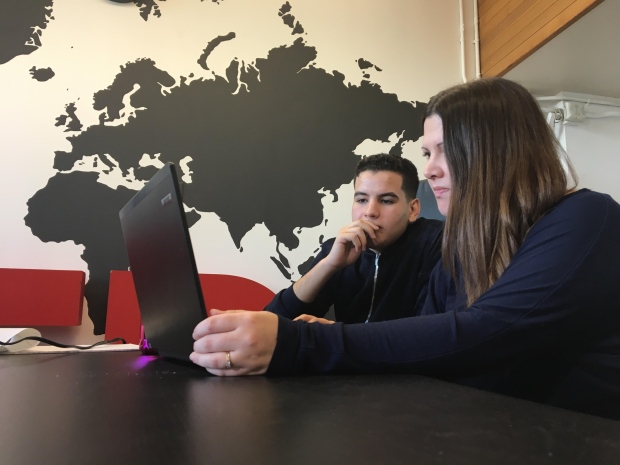
Badr El Bakkali El Kasmi, and his teacher, Renee Stewart, discuss notes before next week’s conference. (CBC)
A Grade 12 student at Edmonton’s Queen Elizabeth High School is heading to Bonn, Germany, with his teacher next month to present a paper about how climate change is affecting Indigenous peoples in Canada.
Since the beginning of the school year, Badr El Bakkali El Kasmi and his classmates have been writing about Lubicon Lake band members, and how Alberta’s oilsands have affected their lives.
El Kasmi will be the sole Canadian delegate at the Bonn Climate Change Conference and will be joined by 19 other students from as far away as China and India.
“Just being able to collaborate and solving this problem as a world united is just really interesting and I’m very honoured to represent the Canadian youth’s voice,’ El Kasmi said Friday.
“A lot of times when it comes down to climate change, we don’t get to see the different perspectives,” he added.
Since early September, he has been collaborating with hundreds of teens from around the world via video conference calls to discuss their research and develop ideas to present at the Bonn conference.
‘Different perspectives’
The Bonn Climate Change Conference runs from November 6-17.
Accompanying El Kasmi will be his social studies teacher, Renee Stewart.
Stewart said the opportunity was born out of a club at the high school called Global Connect.
The club garnered so much interest, it was eventually turned into a class where students could earn credits while studying social issues from around the world, Stewart said.
‘Fantastic experience’
Stewart said El Kasmi showed a lot of leadership skills in the program and that was a big part of why he was chosen as Canada’s delegate.
“I think it’s going to be a fantastic experience for Badr, ” said Stewart.
“He takes a leadership role, he’s very charismatic. I think this is going to define who he is and kind of where his path is going to take him past high school, because he’s been so passionate about this project.”
For El Kasmi, the last month spent researching the Lubicon band has been an eye-opening experience.
“We need to represent everyone in this current situation because climate change is a disastrous situation,” he said.
“The people who are being confronted a lot by this situation are Indigenous people from around the world and I believe that they do need to have a voice and I believe this paper is trying to give them a voice.”
El Kasmi and his class also plan to present the paper to the Alberta government once he returns from Germany.