Lance Morrow calls these past few years “his journey” as he’s come to learn not only of his Indigenous heritage but also about a birth brother he didn’t know existed — a journey he hopes isn’t at a dead end.
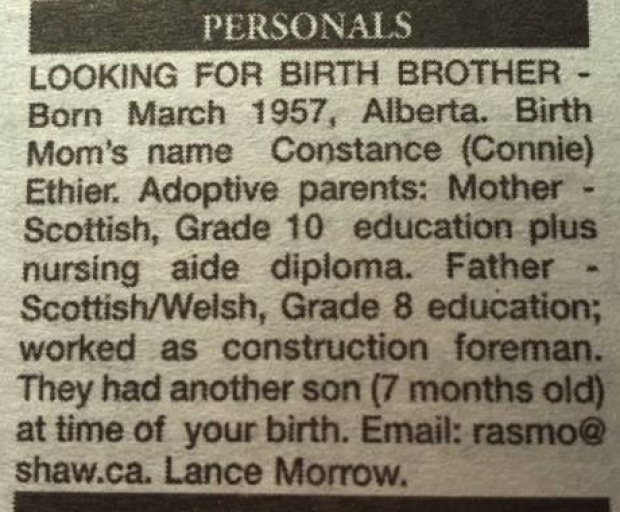
At 53, Morrow has purchased classified ads in 110 community newspapers across Alberta, searching for his long-lost older brother with all of the information he has about his brother’s adoption — which isn’t much. The ad consists of the adoptive parents’ education levels and career paths, and a couple of dates.
The fact he has a brother was among a series of secrets his mother, Connie Ethier, kept from him until her death more than a decade ago. He and his younger sister grew up into adulthood thinking first of all, that it was just the two of them; secondly, that they were Caucasian.
Morrow’s journey over the past few years has taken him on some detours to learn more about Calgary’s storied Stampede Wrestling and the Sixties Scoop — and it’s developed into a mission of self-discovery, not only for him but also for his wife and two young daughters.
This ad was listed in 110 community newspapers across Alberta and Northwest Territories. (Submitted by Kim Rasberry)
A secret that ‘just sat there for years’
Ethier died in 2002, but just before her passing, she dropped the two bombshell secrets of their heritage and extra sibling — but only to Morrow’s sister.
“My mother had said something to my sister, I’m not sure what exactly was mentioned, but something to the regards of ‘we had a brother,'” Morrow recalled.
“I’d spoken to
[my mother] one evening and she just didn’t really want to talk about it. She was just really standoffish and really wouldn’t answer. Just one word answer kind of thing. So I ended the conversation and it just sat there for years.”

This photo shows Lance Morrow’s parents wedding in June 1957, three months after she would have given up her oldest son for adoption. (Submitted by Kim Rasberry)
Initially, Morrow said he didn’t believe his sister, and with no confirmation from his mother, he dropped it. But more recently, Morrow and his family started pursuing ancestry and his family lineage online, and then came the first strand of proof his sister had been telling the truth: he had Indigenous roots.
Curiosity bubbled up and gnawed away at Marrow until one day he and his wife decided to fill out an application with his mother’s information on it and sent it in to the post-adoption registry in Alberta — at the time, not knowing if there would be any file that existed for them to dig up.
“And so he was born in Calgary, his sister was born in Calgary, his parents married in Calgary, so we decided to start with the post-adoption registry in Alberta,” Kim Rasberry, Morrow’s wife said.
About a month later they received a letter in the mail — Morrow had a brother.
“Finding out about my family history, and then finding out I had a brother now, it was just like wow, this is kind of neat. So the ball has just been rolling along here, finding out all kinds of stuff I never knew about,” Morrow said.
Who was Connie Ethier?
A big part of what Morrow is learning about now is his mother’s past and why she would have kept these secrets from her kids.
When Ethier said she was from “up north,” Morrow thought she was alluding to Edmonton, where she had spent some time, or something to that effect. In fact, she was born and raised in Aklavik, N.W.T. It also turns out his family extends to a great aunt who won the Order of Canada, and a great uncle was a Gwich’in First Nations chief.
In a completely different vein, records from 1953 and 1954 show that Ethier was one of the female wrestlers in Alberta and part of Calgary’s famed Stampede Wrestling.
“Seven thousand Edmonton wrestling fans rocked and roared at the Gardens Tuesday as seven curvaceous babes let their hair down and engaged in a battle royal in the main event of promoter Al Oeming’s weekly wrestling card. … Connie Ethier of Edmonton … was the first to go as the six others pounced on her almost immediately,” a report from the Edmonton Journal on June 10, 1953 read.

This clipping comes from the June 10, 1953, edition of the Edmonton Journal. (Edmonton Journal/Google Newspaper Archives)
From reaching out to friends and family they’ve been able to piece together parts of Ethier’s life, moving from Aklavik, to Edmonton, then to Calgary.
Morrow says he struggles with the feelings he has toward his mother about these late-in-life revelations.
“Hurt I guess is the word. Hurt that she wanted to keep it inside for so long and not tell anybody, not even her own kids,” he said.
“I can’t go back to her and say this is what I got, what happened or why. It must have been tough on her just to keep that inside for years. It must just have been eating at her… There’s a lot of whys, it’s tough.”

Connie Ethier as a child with her mother in Aklavik, NWT. (Submitted by Kim Rasberry)
A possible reason for hiding it all
Rasberry was also close with her mother-in-law and said there is “something strange” about this story that doesn’t line up with everything she knew about Ethier.
“I just have this gut feeling that either the baby was taken away from her against her will, whether that be a part of the Sixties Scoop because she was Aboriginal or in a home for unwed mothers or something. She was only 21 when she gave birth to Lance’s brother,” she said.
Rasberry also finds the timing curious as Ethier married Morrow’s father less than three months after the adoption went through. The pair admit there are other possibilities, but the Sixties Scoop seems the most likely reason why a mother would keep such a secret.
The Sixties Scoop spanned decades and saw Indigenous children removed from their homes and families and rehomed with non-Indigenous people, which resulted in loss of culture and identity for many.
“It would make sense about why she would never speak about being Aboriginal and why she would never speak about the brother. Because maybe she felt if she disclosed she was Aboriginal to anybody that maybe Lance and his sister would have been taken away from her too.”
A Service Alberta spokesperson told CBC News they could not confirm or deny whether or not the file in question was a part of the Sixties Scoop, but the spokesperson added if the adoption occurred between 1955 and 1975 involving an Indigenous mother in Alberta, you could “almost count on it.”

Lance Morrow stands with his wife, Kim Rasberry, and their daughters, Emma and Ava, in Disneyland. (Submitted by Kim Rasberry)
Morrow and Rasberry have written to Premier Rachel Notley asking for biological siblings to be given rights in circumstances such as these, but they have had no response thus far. Meanwhile, Morrow and his family remain hopeful they will soon hear from his long-lost brother, refusing to talk about if they will find him, but rather when.