Even after the devastating Fort McMurray wildfire and an oilsands production shutdown, Wood Buffalo’s regional economic growth is expected to outpace Edmonton, Calgary and Red Deer into 2018.
By the year 2021, the Wood Buffalo Regional Municipality’s GDP should return to where it was forecasted to be had the 2016 wildfire not ravaged the city.
In other words, in three to four years, Fort McMurray’s disaster-induced economic slump should be over.
The Conference Board of Canada highlighted these green shoots in its August outlook for the Wood Buffalo region. The municipality released the report on Tuesday.
According to the report, in 2017 and 2018, Wood Buffalo will register an average real GDP growth of 10.4 per cent. In comparison, Edmonton and Calgary are both expected to see growth of 2.3 per cent, while Red Deer is expected to see two-per-cent growth.
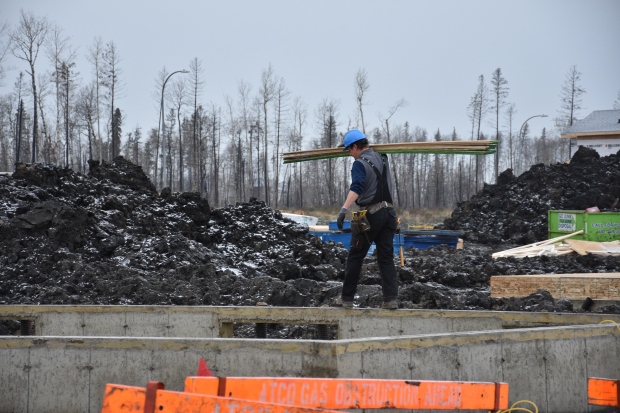
A rebound in oil production and the reconstruction of approximately 2,400 homes and buildings destroyed by the wildfire has boosted the region’s economy, the report said.
A construction worker helps to rebuild two homes on Siltstone Place in Fort McMurray. (Terry Reith/CBC)
Amanda Haitas, Wood Buffalo’s manager of economic development, said the report is a positive sign for the region.
“It’s something that makes us feel we are on track for better days,” Haitas said.
$1.4 billion in lost revenues
The report also outlined how the region’s economy took a beating after the wildfire. Coupled with the already declining price of oil, the wildfire only worsened the economic situation.
Between the evacuation of residents and their re-entry, oil production in the region dropped by more than 1 million barrels per day, resulting in a total loss of 47 million barrels through May and June. That amounted to approximately $1.4 billion in lost revenues.
But the downward trend is reversing, said report author Alan Arcand.

As new oilsands plants come on-line, the Conference Board of Canada says the region’s GDP is expected to keep growing. (Getty Images)
“You will see an impact from the billions of dollars that have been invested in the past,” said Arcand. “And that’s where you are going to see a lot of growth on the production side of the oilsands instead of the investment side.”
Follow David Thurton, CBC’s Fort McMurray correspondent, on Facebook, Twitter or contact him via email.