British Prime Minister Theresa May set out her plan for future ties with the European Union in a speech that she hopes will help spur negotiations over the country’s divorce from the bloc.
Britain is scheduled to leave the EU in March 2019 after a surprise referendum result that has triggered more than a year of political turmoil, put business leaders on edge and sent sterling plunging.
The most complex set of European negotiations since the end of World War Two have pitted London against Brussels over how to unravel over 40 years of economic and political integration.
After three rancorous months of negotiations, May, leader of the world’s fifth largest economy, tried to break the impasse over one of the most symbolically important questions: how much will it cost Britain, in hard cash, to end its EU membership?
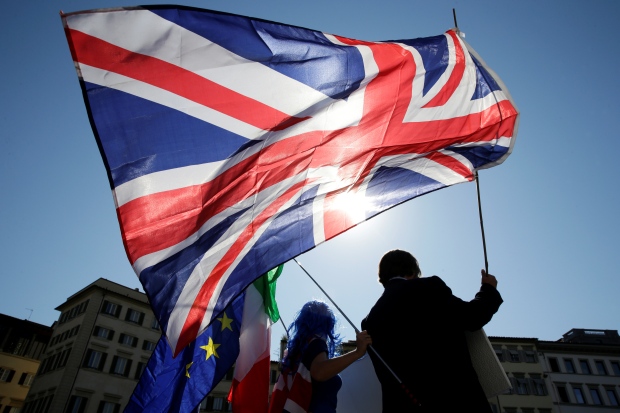
Demonstrators hold flags ahead of a speech by May in Florence, Italy, on Friday. (Max Rossi/Reuters)
“We are moving through a new and critical period in the history of the United Kingdom’s relationship with the European Union. The British people have decided to leave the EU and be a global free-trading nation able to chart our own way in the world,” May said Friday in Florence.
“For many, this is an exciting time full of promise. For others it is a worrying one. I look ahead with optimism.”
Speaking in Florence’s Santa Maria Novella church, May hoped to appeal directly to EU leaders and use the backdrop of a city made wealthy by trade and banking during the Renaissance to underline her wish for Britain to become a major trading power on its own.
But she also faced a small group of protesters outside the 14th century basilica, with Britons living in the Tuscan city saying they want guarantees that their rights will be protected when Britain leaves the bloc.
‘Meets its obligations’
Britain has expressed frustration at the EU’s demand for progress on the exit bill it must pay — if not an exact amount — before talks can move on, with British ministers keen to start negotiating the terms of its new relationship with the bloc.
Brussels has recoiled at Britain’s approach, criticising a lack of detail and policy direction.
The BBC reported that May would say Britain is willing to pay 20 billion euros ($29 billion Cdn) to the EU during a post-Brexit transition period, but only if it has access to the bloc’s single market.

A demonstrator’s banner rests on a bench on Friday in Florence. (Max Rossi/Reuters)
But her transport minister, Chris Grayling, said the speech was not about specific details that would be dealt with during the negotiation but rather driven by May’s wish to set out the principles of future links with the EU.
Asked whether Britain will offer a financial settlement to the EU in the speech, Grayling told the BBC: “We are a nation that meets its obligations.”
May’s office said she would detail her plan for a “time-limited implementation period” – something the government has previously said it thinks is needed to allay business concerns about the exit – but gave no further details.
The EU’s chief negotiator said May needed to make a firm offer on pivotal issues, including the Brexit bill, before the start of the next round of negotiations next week.
“To make progress, we are waiting for clear commitments from the U.K. on these precise issues,” Michel Barnier said.
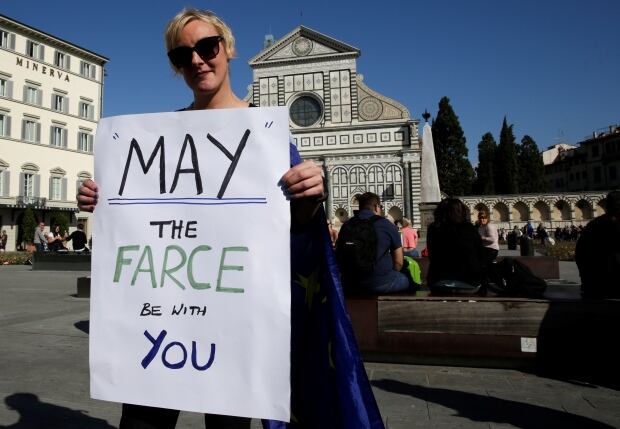
A woman holds up a placard that reads, ‘May the force be with you’ on Friday in Florence. (Max Rossi/Reuters)
May’s speech comes at the start of a crucial week for Europe.
On Sunday, German voters are expected to return conservative Chancellor Angela Merkel to power but also vault eurosceptic parties into parliament, including the Alternative for Germany (AfD) whose nationalist, anti-immigrant ideas echo those of Britain’s UKIP party, a driving force behind Brexit.
Two days later, French President Emmanuel Macron is expected to flesh out his ideas for a “relaunch” of the EU and euro zone, underscoring the bloc’s determination to press ahead with a closer union that excludes the U.K.
‘Allowed Brexit to go sour’
May’s leadership has been hamstrung by the June general election she called to win a mandate for her Brexit strategy but which went badly wrong, costing her party its parliamentary majority and spawning a new debate about how to quit the EU.
On Thursday, May gave her ministers a sneak preview of the speech in her London office, hoping to reduce divisions among ministers who have been arguing over the nature of any transition agreement and how much to pay — a demand by the EU that some of her pro-Brexit lawmakers say is legally baseless.
Those present at Thursday’s preview included Foreign Minister Boris Johnson, one of Britain’s most high-profile pro-Brexit politicians and a one-time leadership contender.
Days earlier Johnson had stoked tension by laying out his own Brexit vision, challenging May’s more cautious approach.
“The view among hardcore Brexiters in parliament … is that somehow we’ve allowed Brexit to go sour,” said a Conservative Party source who asked not to be named.