Acrid, black smoke has been seen pouring from a chimney at the Russian consulate in San Francisco a day after the Trump administration ordered its closure amid escalating tensions between the United States and Russia.
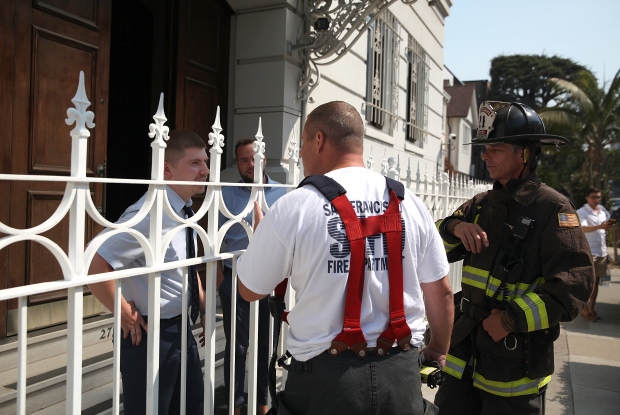
Firefighters who arrived at the scene were not allowed to enter the building Friday.
An Associated Press reporter heard people who came from inside the building tell firefighters that there was no problem and that consulate staff were burning unidentified items in a fireplace.
Mindy Talamadge, a spokesperson from the San Francisco Fire Department, said the department received a call about the smoke and sent a crew to investigate but determined the smoke was coming from the chimney.
“They had a fire going in their fireplace,” she said.
Talmadge said she did not know what they were burning on a day when normally cool San Francisco temperatures had already climbed to 35 C by noon.
San Francisco firefighters talk with workers at the Russian consulate on Friday in San Francisco. (Justin Sullivan/Getty Images)
“It was not unintentional. They were burning something in their fireplace,” she said.
The consulate’s workers are hurrying to shut one of Russia’s oldest consulates in the U.S.
The order for Russia to vacate the consulate and an official diplomatic residence in San Francisco — home to a longstanding community of Russian emigrés and technology workers — escalated an already tense diplomatic standoff between Washington and Moscow.
The deadline for the consulate to close is Saturday.
‘We will respond harshly’
Russia said on Friday it would respond harshly to any U.S. measures designed to hurt it.
The warning, from Foreign Minister Sergey Lavrov, came as Russia said it was weighing a response to the U.S. move that will force it to shut down two trade missions in the United States as well as the San Francisco consulate by Sept. 2.
“We’ll react as soon as we finish our analysis,” Lavrov told students in Moscow. “We will respond harshly to things that damage us.”
Separately, a top Kremlin aide complained the U.S. move pushed bilateral ties further into a blind alley and fuelled a spiral of tit-for-tat retaliatory measures.

Russian Foreign Minister Sergey Lavrov says Russia ‘will respond harshly to things that damage us.’ (Ivan Sekretarev/Associated Press)
U.S. President Donald Trump took office in January, saying he wanted to improve U.S.-Russia ties which were at a post-Cold War low. But since then, ties have frayed further after U.S. intelligence officials said Russia had meddled in the presidential election, something Moscow denies.
Trump, himself battling allegations his associates colluded with Russia, grudgingly signed new sanctions on Moscow into law this month which had been drawn up by Congress.
When it became clear those measures would become law, Moscow ordered the United States to cut its diplomatic and technical staff in Russia by more than half, to 455 people.

The U.S. Embassy is seen in Moscow on July 28. Lavrov hinted on Friday that Russia might look at ordering further reductions in U.S. embassy staff. (Alexander Zemlianichenko /Associated Press)
Lavrov hinted on Friday that Russia might look at ordering further reductions in U.S. embassy staff, suggesting Moscow had been generous last time by allowing Washington to keep “more than 150” extra people.
He said Russia had cut the U.S. numbers to tally with the number of Russian diplomats in the United States, but that Moscow had generously included more than 150 Russian staff who work at Russia’s representation office at the United Nations in its count.
‘Tit-for-tat sanctions was not started by us’
Lavrov said Moscow still hoped for better relations and blamed Trump’s political foes for the deteriorating situation.
“I want to say that this whole story with exchanging tit-for-tat sanctions was not started by us,” Lavrov said.
“It was started by the Obama administration to undermine U.S.-Russia relations and to not allow Trump to advance constructive ideas or fulfil his pre-election pledges.”
Barack Obama, then outgoing president, expelled 35 suspected Russian spies in December and seized two Russian diplomatic compounds. President Vladimir Putin paused before responding, saying he would wait to see how Trump handled Russia.
“We thought this administration could exercise common sense, but unfortunately the Russophobes in Congress are not allowing it to,” said Lavrov, who complained that the United States had only given Moscow 48 hours to comply with its latest demands.