
Hurricane Maria barrelled toward the Turks and Caicos on Friday after lashing Puerto Rico and other Caribbean islands with winds and rain that destroyed homes, caused flooding, devastated economies and left at least 32 people dead.
Maria is the second major hurricane to hit the Caribbean this month and the strongest storm to hit the U.S. territory of
Puerto Rico in nearly 90 years. It knocked out the island’s power and several rivers hit record flood levels.
At least 15 people were killed in Puerto Rico, El Nuevo Dia newspaper reported.
Fourteen deaths were reported on the island nation of Dominica, which has a population of about 71,000. Two others
were killed in the French territory of Guadeloupe and one on the U.S. Virgin Islands.
Death toll likely to rise
The death toll in the Caribbean is likely to rise when searches resume at daybreak.
Puerto Rico Gov. Ricardo Rossello imposed a dusk-to-dawn curfew through Saturday for the island’s 3.4 million people.
Irma Torres Rodriguez tries to stay calm after losing a portion of her roof to the fury of Hurricane Maria in Puerto Rico. The storm was expected to approach the Turks and Caicos Islands and the Bahamas late Thursday and early Friday. (Carlos Gusti/Associated Press)
“If it is not an emergency situation, people should remain in their homes or shelters,” he was quoted as saying by El Nuevo Dia.
Among those killed in Puerto Rico were eight people who drowned in Toa Baja, about 32 kilometres west of San Juan,
Mayor Bernardo Mirquez told the newspaper.
Thousands rescued
More than 4,000 people were rescued from flooded areas of Toa Baja, he was quoted as saying.
Three elderly sisters were killed by a mudslide on Wednesday in the mountainous central municipality of Utuado, El Nuevo Dia said, citing relatives and the mayor of Utuado.
‘They’re not gonna find home … everything will be lost’0:56
In the heart of the island’s capital San Juan, which has a fort and buildings from the Spanish colonial era, the storm left
a trail of wreckage. Toppled trees cut power lines and streets were turned into rivers.
U.S. President Donald Trump told reporters the island had been “totally obliterated” and he planned to visit.
Legalities on hold
Puerto Rico was already facing the largest municipal debt crisis in U.S. history.
A team of judges overseeing its bankruptcy has advised involved parties to put legal proceedings on hold indefinitely
as the island recovers, according to a source familiar with the proceedings.

Power lines are down in Humacao, Puerto Rico, after the impact of Hurricane Maria. (Carlos Giusti/Associated Press)
Maria is a Category 3 hurricane on the five-step Saffir-Simpson scale, with sustained winds of up to 205 km/h. It was 70 kilometres east-southeast of Grand Turk Island as of 2 a.m. ET, the U.S. National Hurricane Center said.
It was forecast to bring storm surges of up to 3.7 metres to the southeastern Bahamas as well as the Turks and Caicos,
it said.
Flash flood watch
Maria was expected to bring as much as 102 centimetres of rain to Puerto Rico and an island-wide flash flood watch was in effect. Between 20 to 40 cm of rain was expected on Turks and Caicos, which could cause flash floods and mudslides, the NHC said.
Maria looked unlikely to hit the continental United States but its storm swells will reach the U.S. southeastern coast from
Friday, the NHC said.

A car is viewed stuck in a flooded street in Santurce, in San Juan, Puerto Rico, on Thursday. (Hector Retamal/AFP/Getty Images)
Utility crews from the U.S. mainland were headed to Puerto Rico to help restore the power grid and the U.S. military sent ground forces and aircraft to assist with search and rescue.
More than 95 percent of wireless cell sites were not working on Thursday afternoon on the island, the U.S. Federal
Communications Commission said. In the U.S. Virgin Islands, more than three-quarters of cell sites are out of service.
Long road to recovery
In Dominica, Maria damaged about 95 per cent of roofs, the UN Office for the Coordination of Humanitarian Affairs said.
It struck as a Category 5 storm on Monday, ripping foliage off plants and obliterating the island’s vital agricultural sector.
The storm caused flooding in the Dominican Republic when it passed nearby from Wednesday night.
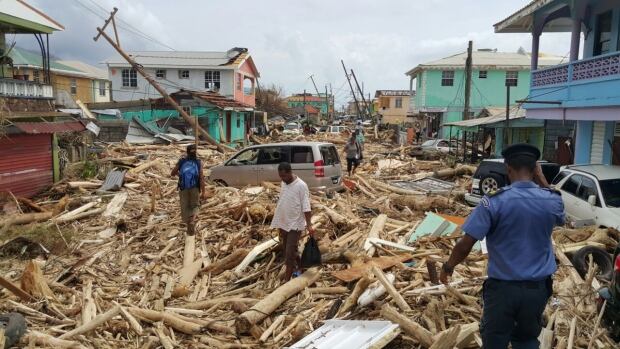
View of damage caused on Tuesday by Hurricane Maria in Roseau, Dominica. (AFP/Getty Images)
Maria passed close by the U.S. Virgin Island of St. Croix, home to about 55,000 people, early on Wednesday as a Category 5 storm, knocking out electricity and most mobile phone service.
“The worst is behind us,” Virgin Islands Governor Kenneth Mapp told reporters on Thursday. The government has imposed a 24-hour curfew until further notice.
Hundreds in shelters
About 600 people throughout the U.S. Virgin Islands are in emergency shelters and many parts are without power, Mapp said.
“It’s going to be a long road to recovery,” Mapp said. Maria hit about two weeks after Hurricane Irma pounded two other U.S. Virgin Islands: St. Thomas and St. John.
Irma, one of the most powerful Atlantic storms on record, killed at least 84 people in the Caribbean and the United
States. It followed Harvey, which killed more than 80 people when it hit Texas in late August and caused flooding in Houston.
More than two months remain in the Atlantic hurricane season, which runs from June 1 to Nov. 30.