U.S. President Donald Trump unveiled his strategy on Afghanistan Monday night. A pillar is that the U.S. will not reveal dates, troop numbers or plans for America’s longest military conflict.
With Taliban insurgent forces no nearer to defeat, current U.S. troop numbers are about 8,400.
“Conditions on the ground will determine” U.S. strategy, Trump said. “I will not say when we are going to attack, but attack we will,” he declared.
He also opened a door to the Taliban, saying a future settlement “could include elements of the Taliban.”
The U.S. will no longer use its military for nation-building abroad Trump said.
He also announced a change in approach to how the U.S. will deal with Pakistan. That country “has much to lose by continuing to harbour criminals and terrorists,” he said.
And the U.S. will develop a strategic partnership with India, Trump said.
Trump long skeptical
Trump has long been skeptical of how the United States is fighting the war in Afghanistan, which was launched by President George W. Bush in October 2001.
Trump announced a strategic review soon after taking office in January and has privately questioned whether sending more troops is wise, U.S. officials said.
“We’re not winning,” he told advisers in a July meeting, questioning whether U.S. Army General John Nicholson, who leads U.S. and international forces in Afghanistan, should be fired, an official said.
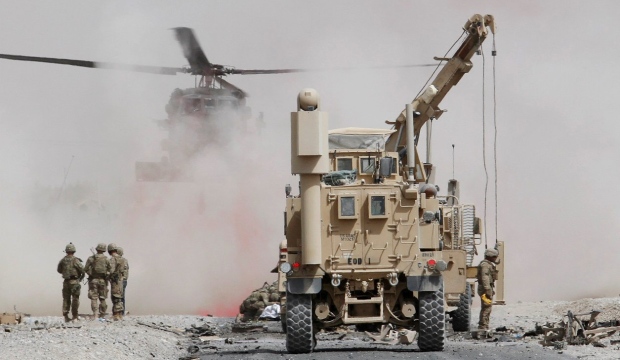
U.S. troops assess the damage to an armoured vehicle of NATO-led military coalition after a suicide attack in Kandahar province, Afghanistan August 2, 2017. (Ahmad Nadeem/Reuters)
But Defence Secretary Jim Mattis has argued that a U.S. military presence is needed to protect against a continuing threat from Islamist militants.
Earlier this year, Trump gave Mattis the authority to set troop levels in Afghanistan.
Two participants in the months-long discussion about an Afghan strategy expected the president to reiterate his authorization for Mattis to decide the troop level, thus giving the green light for the military to send more forces to Afghanistan.
A U.S.-led coalition invaded Afghanistan and overthrew the Islamist Taliban government for harboring al-Qaeda militants who plotted the Sept. 11 attacks. But U.S. forces have remained bogged down there through the presidencies of Bush, Barack Obama and now Trump. About 2,400 U.S. forces have died in Afghanistan since the invasion.
Afghan ‘mess’
“I took over a mess, and we’re going to make it a lot less messy,” Trump said when asked about Afghanistan this month.
The Republican president delivered his third prime-time address to the country as president from Fort Myer military base in Virginia, just across the Potomac River from Washington.

An Afghan National army soldier stands guard a checkpoint on the outskirts of Kabul, Afghanistan, Aug. 21. (Rahmat Gul/Associated Press)
When former president Barack Obama announced the decision to send some 30,000 additional soldiers and Marines to Afghanistan late in 2009, he said at the same time that the so-called “surge” would last 18 months, a time limit widely criticized by U.S. military commanders.
A Pakistani army spokesman said on Monday that, “There are no terrorist hideouts in Pakistan.” Spokesman Major General Asif Ghafoor told a media briefing in Islamabad, “We have operated against all terrorists, including (the) Haqqani network,” which is allied to Afghan Taliban insurgents.
Afghan security forces have struggled to prevent advances by Taliban forces. The war confounded the Obama administration, which first committed an increase of tens of thousands of U.S. troops to reverse Taliban gains, then committed to a troop drawdown, which ultimately had to be halted.
U.S. military and intelligence officials are concerned that a Taliban victory over Afghan President Ashraf Ghani’s government would allow al-Qaeda and ISIS’s regional affiliate to establish bases in Afghanistan from which to plot attacks against the U.S. and its allies.

Afghan President Ashraf Ghani attends Afghan Independence Day celebrations in Kabul, Afghanistan Aug. 19. U.S. Vice President Mike Pence, at Trump’s request, spoke to Ghani on Monday ahead of the address, a White House official said. (Mohammad Ismail/Reuters)
“What we need to do is make sure that Afghanistan isn’t a breeding ground for things that can come back and hurt us or our allies,” Senator Tim Kaine, a Democrat and member of the Senate Armed Forces Committee, told MSNBC.
U.S. Vice-President Mike Pence, at Trump’s request, spoke to Ghani on Monday ahead of the address, a White House official said. Secretary of State Rex Tillerson spoke to his Indian and Afghan counterparts as well as Pakistani Prime Minister Shahid Khaqan Abbasi, the State Department said.
Conflicting opinions
U.S. commanders have long planned for a possible shift in resources from Iraq to Afghanistan as the fight against Islamic State comes off its peak, following gains made in the Iraqi city of Mosul and other areas.
One reason the White House decision took so long, two officials who participated in the discussions said on Sunday, is that it was difficult to get Trump to accept the need for a broader regional strategy that included U.S. policy toward Pakistan.
Trump received a wide range of conflicting options, the officials said.
White House national security adviser H.R. McMaster and other advisers favored accepting a request by Nicholson for some 4,000 additional U.S. forces.
But recently ousted White House strategic adviser Steve Bannon had argued for the withdrawal of all U.S. forces, saying the war was still not winnable, U.S. officials said. Bannon was fired on Friday by Trump.
The officials said that another option examined was to shrink the U.S. force by some 3,000 troops, leaving a smaller counterterrorism and intelligence-gathering contingent to carry out special operations and direct drone strikes against the Taliban.