Indian melodrama “Rangoon” somehow manages to be emotionally resonant despite being overstuffed. This is no small feat given how many different genres, tones, and characters this film juggles. “Rangoon” is, amongst other things, a politically naive WWII drama, an infectious putting-on-a-show musical (complete with accomplished song and dance numbers), and a soapy menage-a-trois romance between an actress, a director, and a soldier. This film is immodestly scaled and frequently implausible but somehow manages to be far greater than the sum of its parts. “Rangoon” is also that rare Indian film I can recommend to anyone who isn’t necessarily already interested in Bollywood or Hindi-language cinema, and a charming crowdpleaser despite its myriad little flaws.
Directed and co-written by Vishal Bhardwaj (Indian Shakespeare adaptations “Maqbool,” “Omkara” and “Haider”), “Rangoon” puts many Indian films to shame when it comes to yanking on viewers’ heartstrings. This is a movie that does not make significant political or narrative sense since it’s essentially a big bowl of cinematic Neapolitan ice cream, except all three flavors are mixed together before-the-fact. Events kick off with a brief (and over-simplified) historical primer on the Indian National Army (INA), and their drive to take India back from the British by joining the Japanese in their fight against the Allies. The INA is not accorded much political importance by their Japanese allies, so they’re forced to fight the Brits through counter-intelligence and espionage. But there are also Indian soldiers, like Nawab Malik (Shahid Kapoor), fighting the Japanese. These guys are also essentially expendable, as we see when Nawab is immediately captured by Japanese soldiers after his fellow soldiers abandon him.
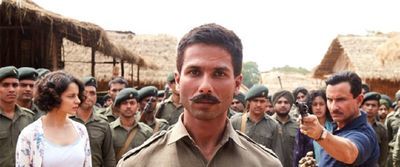
Switch to another place, albeit at roughly the same time: stunt-woman/movie star Julia (Kangana Ranaut) has been tasked by her filmmaker paramour Rustom “Rusi” Billimoria (Saif Ali Khan) with entertaining British troops in Burma. Rusi is a handicapped actor with a stump for a right hand, and an unhappy, financially independent wife. But he’s not just a cad: Rusi is a British collaborator who makes deals whenever he knows he can’t get away without them. This trait is one that Rusi will eventually be disabused of, making him the strongest character in “Rangoon.” But in the beginning, he’s just an emotionally unavailable tycoon who treats his mistress Julia like a pawn, and accordingly fails to anticipate that somebody else—like Nawab, who serves as Julia’s bodyguard during her tour of Burma—might win her over if he doesn’t act fast.
Nawab is probably the weakest of the film’s three characters since his inner life is often taken for granted. There’s a portion of “Rangoon” where he takes center stage, and it plays out a bit like “The Bodyguard” meets “Rambo: First Blood Part II.” Nawab and Julia bond after they’re separated from the British army, and must fend for themselves for several days, searching for food and shelter in Japanese bunkers and bombed-out Burmese villages. This portion of the film is a bit creaky, but it’s effective because it establishes Nawab as a sympathetic man of action who cares about prisoners of war. It also features a genuinely sexy moment between Khan and Ranaut: Nawab takes his time examining her naked back for leeches, uncovering a scar just over her hips.
“Rangoon” loses a bit of its narrative simplicity once Nawab and Julia return to the British camp, and the film gravitates towards Rusi. This wouldn’t be such a bad thing if Rusi wasn’t, for most of the film’s second half, such a generic jealous lover. He flies into a tizzy when he notices Nawab and Julia’s furtive glances and not-so-secret rendezvous, though it takes some time before he decides to act on his feelings. Still, rather than beating Julia, Rusi channels his rage through espionage hijinks that are only introduced later in the film. Long story shortish: there’s an INA spy relaying messages about the Brits’ maneuvers, and nobody knows who it is (though I’m sure you can guess). By film’s end, “Rangoon” uses Rusi, Julia and Nawab’s three-way romance as a means of situating a divided country’s conflicted feelings about being subjugated by foreign imperialists. Julia resents Rusi’s insistence that she is his creation while Rusi grows to dislike being told what to do by cartoonishly evil British General Harding (Richard McCabe). Nawab, a British POW forced to fight against his fellow countrymen, has his own baggage, but it’s hard to get into without giving a key plot point away.
Still, the most remarkable thing about “Rangoon” isn’t how seamless its plot mechanics are, or how ideologically nuanced it is. What matters is that this is a film whose creators, at its best moments, foreground the characters. It’s a love story featuring catchy songs, and well-choreographed dance numbers, and it features a heroine who isn’t just a cliched harpy one minute, and an ass-kicking femme the next. “Rangoon” may climax with big, showy war movie pyrotechnics, and a showdown that leaves more main characters dead than alive. But even that succeeds given how hard Bhardwaj and his co-creators work to get you to care about their film’s ever-escalating stakes. “Rangoon” may not seem like your thing, but you should give it a try. You’ll be glad you did.