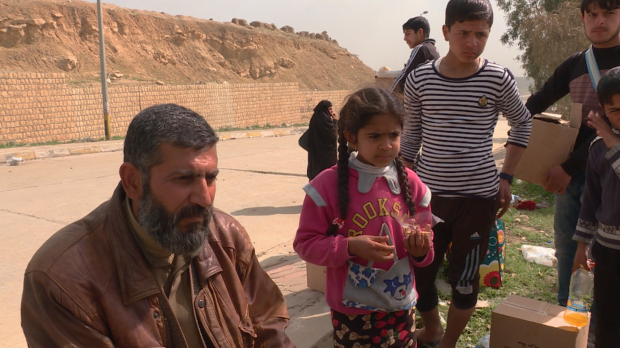
It was finally Abu Fahad’s time.
The Iraqi army rolled up to his family’s home in western Mosul on Sunday, giving the father of seven children and his wife their chance to escape ISIS.
“We had to live under their rules. We lived in fear,” Fahad said. “If we didn’t do what they wanted, they would kill us.”
Fahad’s family is one of thousands who have fled heavy fighting in recent days, as Iraq’s security forces are locked in an intense battle with ISIS, which continues to lose ground in the city it’s controlled for more than two years.
Abu Fahad and his family stopped for some food and sweets after fleeing western Mosul on Sunday. (Glen Kugelstadt/CBC)
The battle to wrest Mosul away from ISIS is the most significant military operation mounted against the jihadist group.
The prize is not only Iraq’s second largest city, but victory for Iraqi forces that will signal the beginning of the end for militants in Iraq.
Life under the caliphate
When ISIS seized Mosul in June, 2014, its lightning-fast victory made the world take notice of the jihadists, who until then had been regarded as little more than a group of regional terrorists.
But with attacks on other Iraqi cities, including Fallujah and Ramadi, the world got its first glimpse of the brutal methods employed by the jihadists — beheadings, mass executions, and the rape and enslavement of women.

An Iraqi girl holds her sister as her family boards a bus to take them to a camp for residents of Mosul displaced by the ongoing fighting for control of the city between Iraqi security forces and ISIS. (Tracy Seeley/CBC)
Mosul is also the place where ISIS leader Abu Bakr al-Baghdadi declared a caliphate — a geographic area ruled under Islamic law, headed by a caliph, a person regarded as a successor to the Prophet Muhammad.
Winning back Mosul will also boost morale for Iraq’s army, which fled Mosul so quickly in June, 2014, that some soldiers left their guns behind.
Last urban area under ISIS
Some 100,000 soldiers, police officers and militia men linked to the Iraqi government and Kurdish Peshmerga forces are expected to take part in the battle to retake the city.
The military operation was launched in October, 2016. In January, Iraq’s Prime Minister Haider al-Abadi declared the eastern part of the city liberated. The operation to win control of western Mosul began on Feb. 19.
Soldiers celebrated their continued advances, with young military men buoyantly cheering their gains and pointing out the bodies of fallen ISIS fighters decomposing in the streets near the ever-changing front lines.

Mosul residents load their possessions on buses after fleeing the western part of the city, as they head to camps for displaced people. (Derek Stoffel/CBC)
Mosul is the last urban centre in Iraq under ISIS control. Iraqi security forces pushed the militants out of Ramadi and Fallujah, improving their tactics and learning lessons for what would be their most important battle: Mosul.
Iraqi government forces are expected to prevail in Mosul — few doubt that. There are reports that Baghdadi, the ISIS leader, has told his men they are free to flee to Syria, or stay and fight to the end.
What comes next
The big question is what happens when ISIS is pushed out?
“There’s no good plan. And that’s partly because the central government is absolutely cash strapped,” said Bessma Momani, a professor of international relations at the University of Waterloo.
“It doesn’t have the resources to invest in what needs to be an important local initiative to win the hearts and minds of the population who haven’t been served by the Iraqi government.”
The real worry after the guns fall silent is the eruption of a sectarian struggle between Sunni Muslims, some who may have initially supported ISIS, and Shias who were persecuted under the jihadists and will find it difficult to feel safe in Mosul.
Many Assyrian Christians, who were also targeted by ISIS, say they will not return to their homes.

A boy waits for his father, who was being questioned for ties to ISIS, at an assembly point for displaced residents of Mosul on Sunday. (Derek Stoffel/CBC)
Canada’s involvement
Canada is one of a number of Western nations supporting efforts to rebuild the city, and the wider region, when the fighting is over.
The federal government has committed to spending $158 million in humanitarian and developmental assistance in Iraq, under a three-year plan that ends in 2019.
Canadian money is helping UNICEF work with children who have grown up under the nightmares of war.
Ottawa is also supporting programs to improve water quality, make sure residents have enough food to eat, and remove home-made bombs from the countryside.
Canada also has a military presence on the ground in northern Iraq, with a group of Canadian Special Forces soldiers training Kurdish Peshmerga.
While the Canadian Forces will not say exactly how many Canadian elite soldiers are involved in the mission — known as Operation Impact — it’s believed there are about 70 Special Forces members involved in the mission. The group has trained 2,400 Iraqi and Kurdish troops.
The military also opened a hospital in Erbil to treat members of the U.S.-led coalition against ISIS, as well as civilians from the region. It is staffed by Canadian Forces medical personnel.

An Iraqi family flees western Mosul as heavy fighting for the control of the city continues. (Derek Stoffel/CBC)
‘Skin in the game’
While the Trudeau government may have pulled the six Canadian CF-18 fighter jets from the international coalition, the Maple Leaf still flies high over the skies of Iraq and Syria.
Canadian military aircraft operate in both a surveillance and refuelling capacity, with support crews based in Kuwait and Qatar.
“Obviously we have skin in the game,” said Prof. Momani of the University of Waterloo.
As ISIS territory shrinks, Momami sees another threat.
“There is a fear that as ISIS is no longer going to have its so-called state, it is going to turn into a classic insurgency and the classic terrorist organization by hitting Western, abroad targets more so than trying to fight to consolidate its existing territory, as we’ve seen in the past few years.”

Bahsar Ibrahim fled Mosul on Sunday with his wife and eight children. Daily life was so bad that the family was forced to burn their furniture in order to bake bread. (Tracy Seeley/CBC)
‘Like living next to death’
In Mosul, for the tens of thousands who have fled the fighting or are living in liberated areas, there is a palpable sense that more than two years of living under the rule of the world’s most brutal jihadists is over.
“It was like living next to death,” said Bashar Ibrahim, who led his wife and eight children to a relative’s home in East Mosul on Sunday. “Now we are living again.”