President-elect Donald Trump’s team could move the White House press briefing room from the West Wing to another location that accommodates more media from around the country, incoming White House chief of staff Reince Priebus said on Sunday.
Esquire magazine reported on Saturday that the Trump administration planned to relocate White House reporters from the press room to the White House Conference Center or the Old Executive Office Building next door.
Speaking on ABC’s This Week, Priebus said the team discussed moving news conferences out of the small West Wing briefing room to the Old Executive Office, which is part of the White House complex. He said no decision had been made.
“I know that some of the folks in the press are uptight about this, and I understand,” Priebus said. “The only thing that’s been discussed is whether or not the initial press conferences are going to be in that small press … the press room that people see on TV is very, very tiny.”
“So no one is moving out of the White House. That is the White House, where you can fit four times the number of people in the press conference, allowing more press, more coverage from all over the country … That’s what we’re talking about.”
Such a move would mark a potential change in access for reporters as the current briefing room is only steps from the Oval Office. The White House Conference Center served as a temporary press room during the George W. Bush administration.
In addition to theatre-style seats where the White House press secretary conducts daily briefings, the press area includes workspace for the news organizations that cover the administration on a daily basis.
Press objections
The current press room has about 49 seats. Trump has long had contentious relations with what he refers to derisively as the “mainstream media,” banning some news outlets during the presidential campaign and publicly criticizing individual reporters.
Those tensions escalated last week after some news organizations reported unsubstantiated allegations that suggested the president-elect could be blackmailed by Russia.
The White House Correspondents’ Association objected in a statement to “any move that would shield the president and his advisers from the scrutiny of an on-site White House press corps,” and said that it would fight to keep the briefing room and access to senior administration officials open. Jeff Mason, a Reuters White House correspondent, is president of the WHCA.
On CBS’ Face the Nation, vice-president-elect Mike Pence said there was a “tremendous” amount of interest in the incoming administration.
“The interest of the team is to make sure that we accommodate the broadest number of people who are interested and media from around the country and around the world,” Pence said.
CIA director urges caution
Also on Sunday, CIA director John Brennan had a stern parting message for Trump days before he assumes the U.S. presidency, cautioning him against loosening sanctions on Russia and warning him to watch what he says.
Brennan rebuked the president-elect for comparing U.S. intelligence practices to Nazi Germany in comments that laid bare the friction between Trump and the intelligence community he has criticized and is on the verge of commanding.
In an interview with Fox News Sunday, Brennan questioned the message sent to the world if the president-elect broadcasts that he does not have confidence in the United States’ own intelligence agencies.

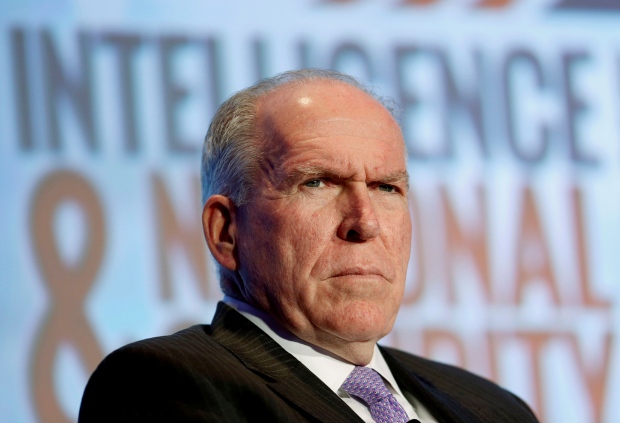
Central Intelligence Agency (CIA) director John Brennan issued a stern warning to the president-elect on Sunday, saying he needs to watch what he says about Russia and be more aware of what he posts on Twitter. (Gary Cameron/Reuters)
“What I do find outrageous is equating intelligence community with Nazi Germany,” Brennan said. “I do take great umbrage at that.”
His comments followed a tumultuous week of finger-pointing between Trump and intelligence agency leaders over the unsubstantiated report of compromising information Moscow had collected on Trump.
Trump accused the intelligence community of leaking the compromising information, which its leaders denied. They said it was their responsibility to inform the president-elect that the allegations were being circulated.
Brennan also sounded an alarm on the topic of U.S. relations with Russia, something Trump has vowed to improve as he fights criticism that he is too eager to make an ally of Russian President Vladimir Putin.
Heading down a uncertain road
Trump does not yet have a full understanding of Russia’s actions, Brennan said, noting its seizure of Crimea from Ukraine, its support for President Bashar al-Assad in Syria’s civil war and Moscow’s activities in the cyber realm.
“Mr. Trump has to understand that absolving Russia of various actions it has taken in the past number of years is a road that he I think needs to be very, very careful about moving down,” he told Fox.
In an interview with the Wall Street Journal published on Friday, Trump suggested he might do away with sanctions imposed by the Obama administration in late December in response to alleged cyber attacks if Moscow proves helpful in battling terrorists and reaching other U.S. goals.
Brennan also said Trump needs to be mindful about his off-the-cuff remarks once he takes the oath of office on Friday, alluding to his penchant for making broad pronouncements on Twitter.
“Spontaneity is not something that protects national security interests,” Brennan said. “So therefore when he speaks or when he reacts, just make sure he understands that the implications and impact on the United States could be profound.
“It’s more than just about Mr. Trump. It’s about the United States of America.”