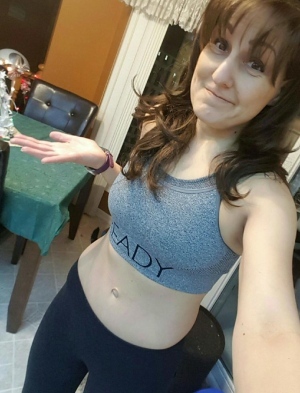
The question remains: Are sports bras acceptable wear at city gyms?
The city released an updated policy this week on what it considers permitted attire at city-run facilities, but the language seems to leave the question unanswered.
“If it’s sport and fitness attire,” said Brad Badger, the city’s director of programs and events. “We know that we have people who want to wear that in our facilities.”
The previous city guidelines didn’t allow for patrons to show their midriffs.
“We’ve gone away from that,” Badger said. “Recognizing that a lot of new products out there are different from what they used to be.”
According to the revised policy, all clothing and footwear must be:
- Clean and free of odours that may affect the experience of other users.
- Free of inappropriate/offensive graphics or language.
- Free of attachments such as buckles/velcro/snaps that might damage equipment.
- Appropriate to the fitness/recreation environment/amenity being used, not be overly revealing, and must be mindful of the comfort of other users.
Step backwards?
Coral Wiebe thinks the revised version is taking a step backwards.
“What they’re saying is that I’m responsible for someone else’s discomfort,” Wiebe lamented. “Not my own comfort, not my own athletic need.”

Wiebe believes clothing policy should be based on common sense-safety concerns.
In December, the 42-year-old mother and fitness buff was working out on a treadmill at the Meadows Community Recreation Centre when she was approached by a staff member, who told her wearing a sports bra was not acceptable.
With language like “be mindful of the comfort of other users,” Wiebe believes the revised policy is more confusing.
“What am I going to do, call ahead to the gym and ask what kind of demographic or group of people is at the gym before I show up?”
Language too subjective
Amy Kaler, a sociology professor at the University of Alberta, agrees the revised language is too subjective.
“What I find overly revealing, someone else might find completely appropriate,” she said.

Kaler recommends the city put up posters or signs at sports facilities, showing anatomical guidelines.
Kaler pointed out there are other reasons people may not feel comfortable at all facilities.
“I don’t like going there when it’s really crowded,” she said. “But that doesn’t mean that the gym staff should tell half the people to leave so that I feel better.”
“There’s a remedy for that–come at a different time, go to a different facility.”
The YMCA has similar language in their policy but it’s not overtly advertised, said Kent Bittorf, vice president of health, fitness and aquatics for the YMCA of northern Alberta.
He said they train their staff to gauge what management believes to be reasonable.
“A standard sports bra that would come to midriff would be fine,” he explained. “I asked some of my management team.
“Where would they sort of draw the line is typically around a sports bra that would be more like a bikini,” he said.
Internal communication to guide staff
Badger said the city has detailed, “internal communication” to guide staff in making a call.
“There’s some depth behind it, certainly, for the staff, to help them,” he outlined. “As far as examples and rationale and questions and answers.”
Badger refused to say whether a definition of a sports bra is included in the internal communication.
Kaler recommends the city put up posters or signs at sports facilities, showing exact anatomical guidelines.
“Anything which removes that judgement call, that ambiguity, and says ‘OK, here are the parts of the body which shouldn’t be visible when you’re working out in a public area,’ I think that would be useful.”
Wiebe, who still goes to Kinsmen and the Meadows Community Recreation Centre, believes the city should only have a say when it comes to safety at the gym.
“We can all dress ourselves, I don’t think we need to be policed. I don’t think men or women need to be told how to dress.”
Badger said the staff at city facilities is being brought up to speed on the revised policy.